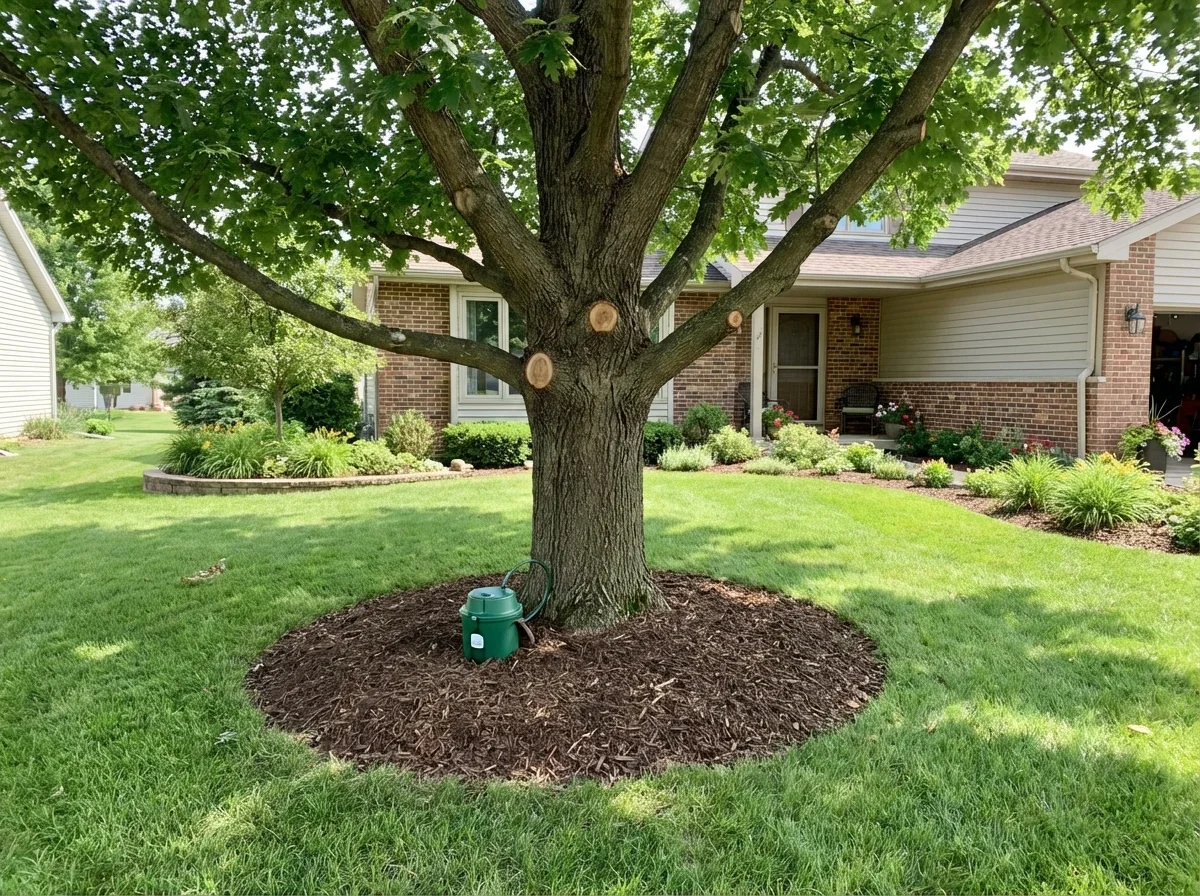
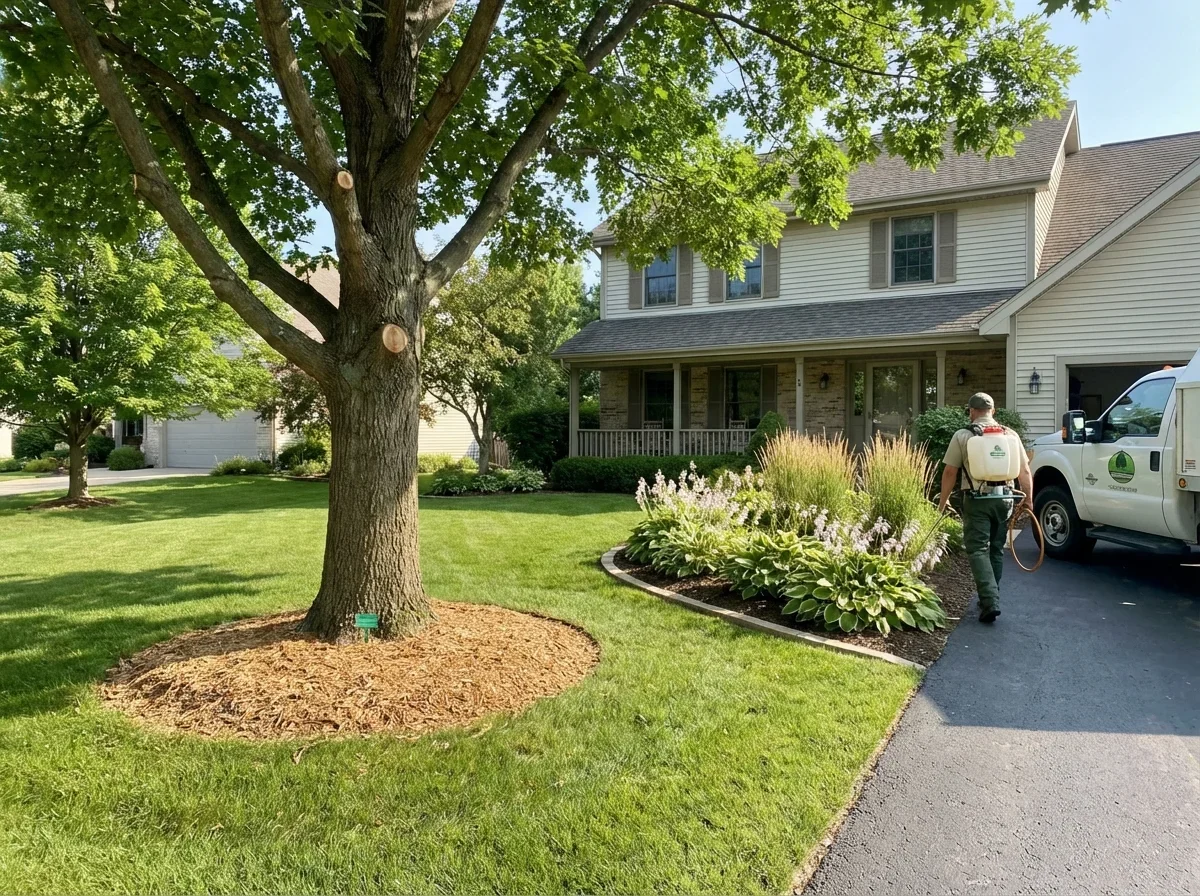
Signs Your Tree Has a Disease Problem
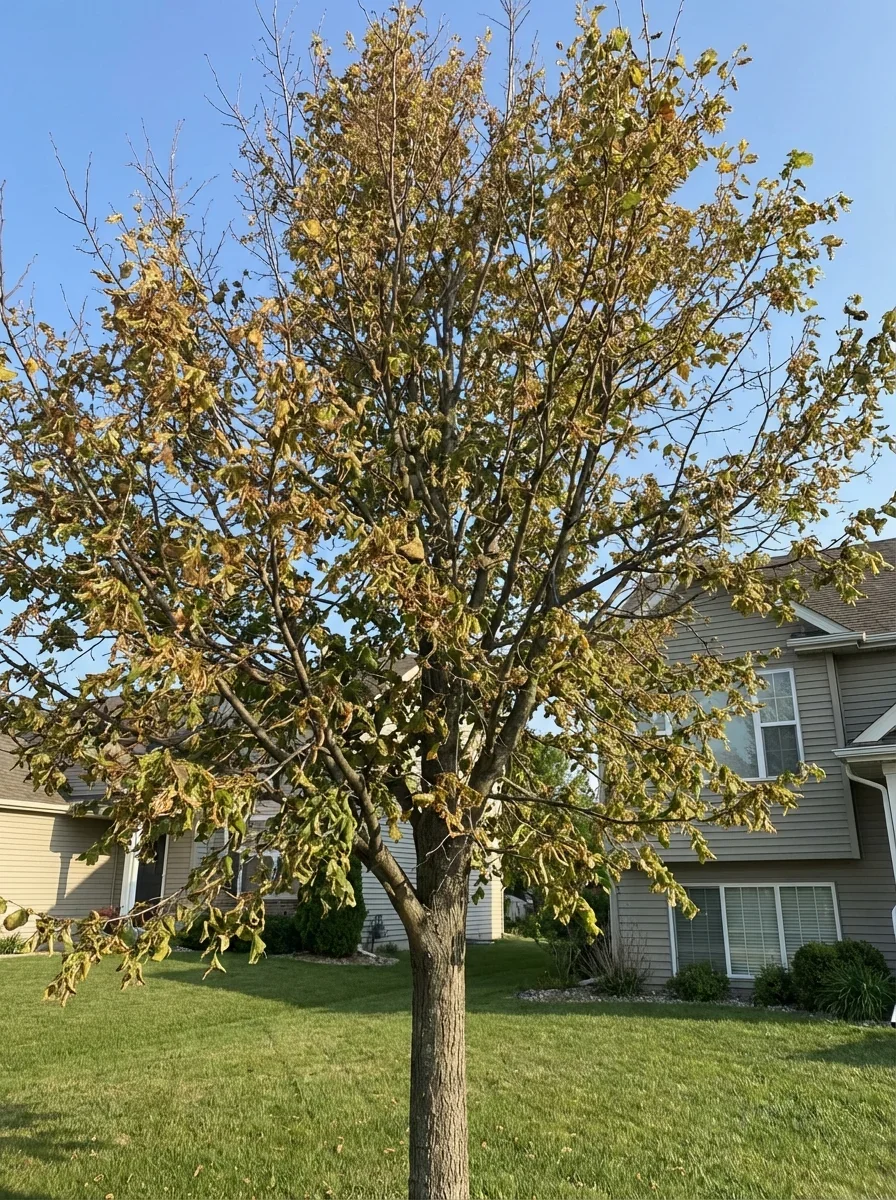
You noticed something wrong weeks ago. Maybe it started with a few brown leaves in June when everything else was green. Or the crabapple that always bloomed stopped flowering. Now half the canopy looks dead, and you're wondering if the tree can be saved.
Here's what makes tree diseases different from pest damage or drought stress: they spread. One infected oak can kill every oak within 50 feet through root grafts. Fire blight jumps from ornamental trees to your neighbor's orchard in a single rain event. Dutch elm disease moves tree-to-tree through beetles, and by the time you see symptoms, the vascular system is already compromised.
Oak wilt is the biggest threat to mature hardwoods in the Fox Valley. Wisconsin DNR's forest health program tracks active infection sites across central and southern Wisconsin, and the disease is established throughout Appleton, Oshkego, and Green Bay areas.[1] Red oaks die within weeks of infection. White oaks can linger for years, spreading the pathogen underground the whole time.
Sound familiar? Your oak's leaves turned bronze in July instead of fall. You thought it was drought. Now entire branches are bare. That's textbook oak wilt — and your other oaks are at risk.
Then there's the bacterial infections. Fire blight makes branches look like they've been torched — black, wilted, bent into a shepherd's crook. Apple scab turns ornamental crabapples into defoliated sticks by August. Anthracnose hits maples and sycamores after wet springs, causing early leaf drop that weakens trees year after year.
The cost of waiting: An untreated oak wilt infection doesn't just kill one tree. Removal of a 60-foot mature oak costs $2,000-$4,000. If it infects three more trees in your yard before you trench the roots? You're looking at $10,000+ in removals. Treatment costs a fraction of that.
Some diseases are manageable. Others require aggressive action within weeks of diagnosis. You can't tell the difference by Googling symptoms.
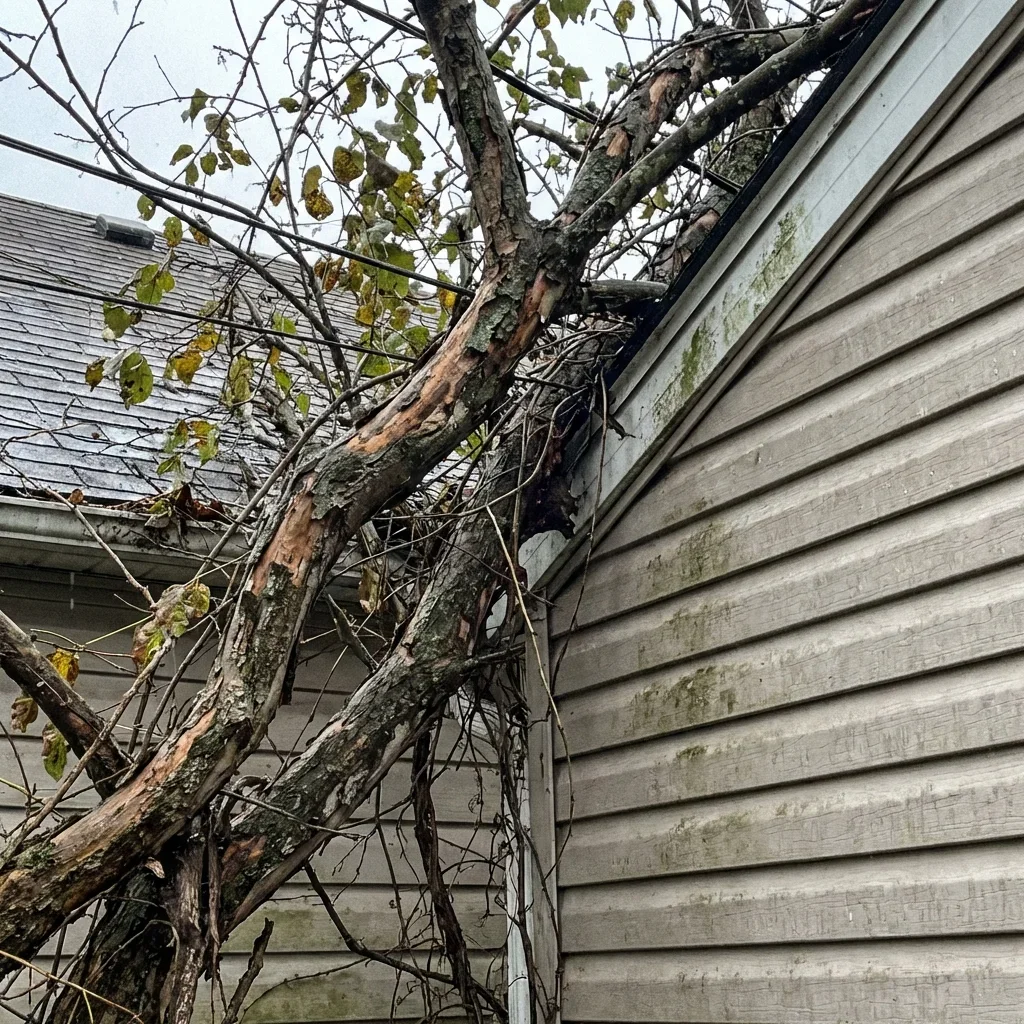
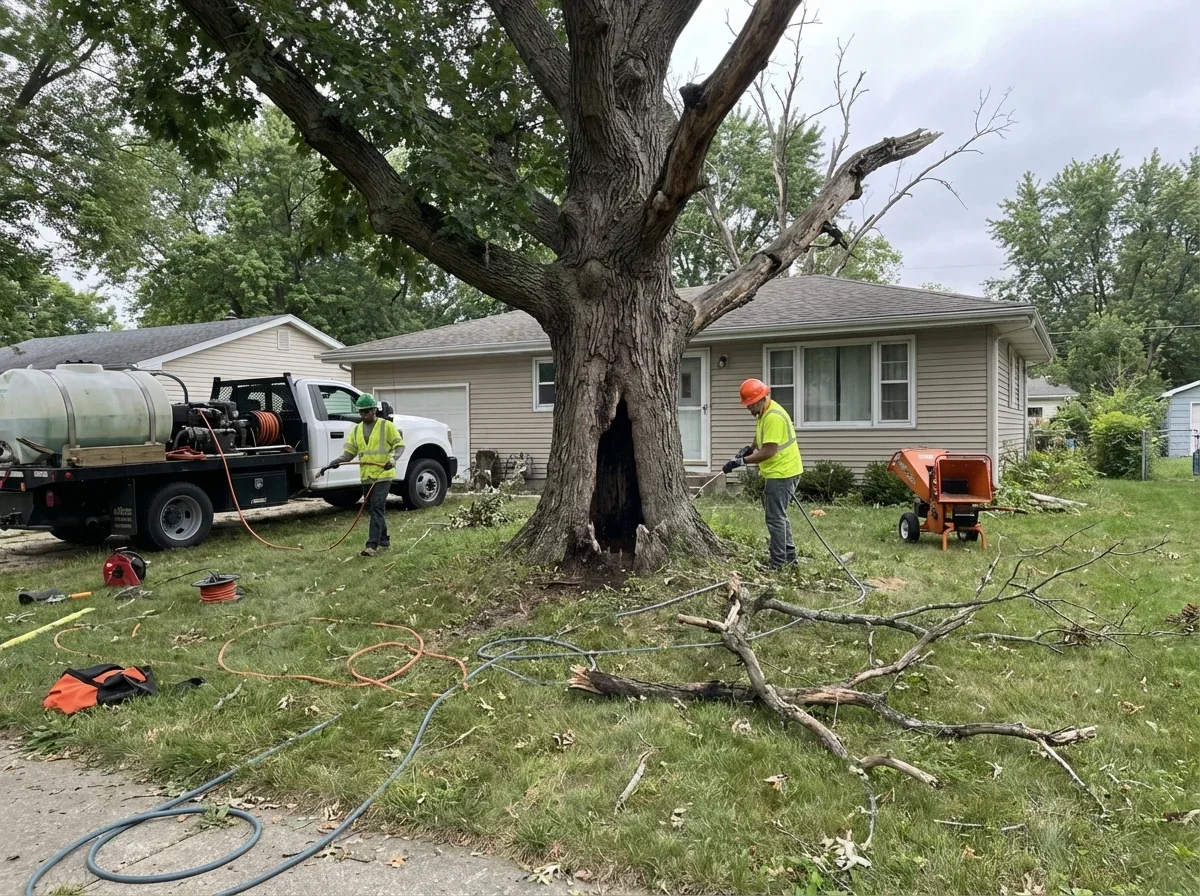
What Does Tree Disease Treatment Cost in the Fox Valley?
Treatment costs depend on three factors: the disease, the tree size, and how far it's progressed. A fungicide injection for a 20-inch oak costs $300. Treating a 40-inch specimen with advanced oak wilt, including root trenching to prevent spread, runs $1,200-$1,800.
Treatment Method Cost Breakdown
| Treatment Method | Best For | Cost Range | Effective Duration |
|---|---|---|---|
| Trunk Injection | Systemic diseases (oak wilt, Dutch elm) | $200-$500 per tree | 2-3 years |
| Foliar Spray | Surface fungi (apple scab, anthracnose) | $150-$400 per application | Single season |
| Soil Drench | Root diseases, preventive care | $180-$450 per tree | 1-2 years |
| Root Trenching | Oak wilt containment | $8-$12 per linear foot | One-time barrier |
Trunk injection delivers fungicides directly into the vascular system. It's the gold standard for oak wilt suppression and Dutch elm disease prevention. Arborists drill small holes and inject under pressure. The tree distributes the fungicide itself. This works for systemic diseases where the pathogen lives inside the wood. Timing matters — injections work best during active growth (May-July) when sap flow is strong.
Foliar sprays coat leaves and bark surfaces. They prevent fungal spores from establishing — think of it as a protective barrier. Apple scab and anthracnose respond well to 2-3 applications timed with new leaf emergence. You're paying per visit, and coverage depends on tree size. A 30-foot crabapple requires more material and spray time than a 15-foot ornamental.
Soil drenches deliver treatment through root uptake. They're slower-acting but effective for certain root diseases and as preventive care for high-value trees. Cost depends on trunk diameter (which correlates to root spread) and soil type.
Tree Size and Severity Factors
Treatment cost scales with diameter at breast height (DBH). A certified arborist measures 4.5 feet up the trunk:
- Small trees (6-12" DBH): $150-$300 per treatment
- Medium trees (12-24" DBH): $300-$600 per treatment
- Large trees (24-36" DBH): $600-$1,000 per treatment
- Specimen trees (36"+ DBH): $1,000-$1,500+ per treatment
Add 30-50% for advanced infections requiring combination treatments. Oak wilt in a mature tree might need trunk injection PLUS root trenching to isolate it from neighboring oaks. That's treatment plus containment.
Prevention costs less than reaction. Fungicide injections for oaks in oak-wilt zones run $200-$400 every 2-3 years. Compare that to $3,000 to remove a dead 50-foot oak. Homeowners in Neenah and Menasha with mature oak populations often invest in preventive treatment after a neighbor loses trees.
Most treatments require 2-3 years of monitoring and potential follow-up. Budget for the full disease management cycle, not just one visit.
The Tree Disease Treatment Process
Effective treatment starts with accurate diagnosis. Symptoms overlap — what looks like oak wilt could be Armillaria root rot or verticillium wilt. What looks like drought stress could be bacterial leaf scorch. Treating the wrong disease wastes money and lets the real problem advance.
Initial Diagnosis and Testing
Step 1: On-site evaluation by an ISA-certified arborist. They examine symptoms, tree history, and site conditions. Wilting pattern, discoloration progression, presence of fungal bodies, bark condition, and neighboring tree health all factor into diagnosis. The evaluation takes 30-60 minutes for a thorough assessment.
This visit identifies whether field diagnosis is sufficient or if lab testing is needed. Oak wilt and Dutch elm disease can often be diagnosed visually by experienced arborists. Bacterial infections and some fungal diseases require lab confirmation.
Step 2: Laboratory testing if required. The arborist collects samples — wood cores, leaves, or root tissue — and sends them to a plant pathology lab. Wisconsin DNR and UW Extension labs process tree disease samples. Results take 1-2 weeks. Lab fees run $50-$150 depending on test type. You need this certainty before committing to a $1,000 treatment plan.
Step 3: Treatment plan with timing window. Once the disease is confirmed, your arborist designs a treatment protocol. This includes method selection, application schedule, and success probability based on disease stage. Some diseases caught early have 85%+ management success rates. Advanced infections drop to 40-60%.
Treatment Application Methods
Injection treatments take 1-2 hours depending on tree size. The arborist drills injection ports around the trunk base, attaches the injection system, and monitors uptake. Trees are typically injected in spring or early summer when sap flow is active. You'll see small drill wounds that compartmentalize and heal within a year.
Foliar spray applications require specialized equipment for large trees — boom trucks or hydraulic sprayers that reach 40-60 feet. Applications happen in early morning or evening to minimize drift and allow leaf absorption. Timing is disease-specific. Apple scab sprays happen at bud break, then 2-3 more times at 10-14 day intervals. Anthracnose treatments start when leaves are half-expanded.
Root trenching for oak wilt containment is heavy work. Operators use vibratory plows or trenchers to cut roots 4-5 feet deep in a continuous line between infected and healthy trees. This severs root grafts that transmit the fungus. The trench needs to extend 15+ feet beyond the infected tree's drip line on the side facing healthy oaks. This is often done in late fall or winter when disease transmission risk is lowest.
Follow-Up Monitoring
Treatment isn't one-and-done. Your arborist schedules follow-up visits to assess response. For fungicide injections, the first check happens 6-8 weeks post-treatment. Are new leaves healthy? Has wilting stopped progressing? Some diseases require a second treatment if the first application didn't fully suppress symptoms.
Annual inspections catch re-infection early. Oak wilt can return if new infection occurs through wounds or insect transmission. Preventive treatments get renewed every 2-3 years while disease pressure remains high in your area. In Kaukauna and other Fox Valley communities with established oak wilt, ongoing management is common for property owners with valuable oak stands.
How to Choose a Tree Disease Treatment Service
Your choice of arborist determines whether treatment works or wastes money. Tree disease diagnosis requires training that typical tree services don't have. You need someone who can differentiate oak wilt from a dozen other wilt diseases, recognize fire blight before it destroys an orchard, and time treatments to disease life cycles.
Certifications to Look For
ISA Certified Arborist credential is baseline. The International Society of Arboriculture certifies arborists who pass comprehensive exams covering tree biology, diagnosis, and treatment. Certification numbers are verifiable through ISA's online directory. This credential means they've studied plant pathology, not just tree removal.
Wisconsin requires arborists who apply pesticides (fungicides, bactericides) to hold a pesticide applicator license through the state Department of Agriculture. Ask for license numbers. Unlicensed applicators can't legally spray or inject chemical treatments.
Board Certified Master Arborist status indicates advanced expertise. Only 3% of certified arborists achieve this credential. For complex disease cases or high-value specimen trees, this level of expertise makes a difference.
Look for continuing education in forest health. Arborists who attend Wisconsin DNR forest health workshops or work with Extension specialists stay current on emerging diseases and treatment protocols. Ask what professional development they've completed recently.
Treatment Approach and Guarantees
Compare how arborists approach diagnosis. The best practitioners:
- Conduct on-site evaluation before quoting treatment. Phone quotes based on photos are guesses.
- Recommend lab testing for uncertain diagnoses. Overconfidence kills trees. Good arborists know when they need lab confirmation.
- Explain success probability honestly. No one can guarantee a 100% cure for advanced oak wilt. If they promise that, walk away.
- Provide written treatment plans. What products, when, how many applications, and what follow-up monitoring is included.
- Discuss prevention for at-risk trees. If they treated one oak for oak wilt, did they recommend preventive injections for your other oaks? That conversation matters.
Ask about their fungicide selection. Different diseases respond to different active ingredients. Propiconazole works for oak wilt. Copper-based products treat fire blight. Generic "tree sprays" don't cut it.
Red flags that indicate inexperience:
- Quoting treatment without seeing the tree in person
- Diagnosing oak wilt without considering alternatives (verticillium wilt, Armillaria)
- Recommending unnecessary treatments ("let's spray everything to be safe")
- Unable to explain their treatment timing — why this month vs next month
- No discussion of what happens if treatment doesn't work
Request references from recent disease treatment clients — not just tree removal or pruning jobs. Call those references and ask if the treated tree recovered, how many follow-up visits occurred, and whether the arborist communicated clearly throughout the process.
Get quotes from at least two certified arborists. Compare their diagnostic approach, not just price. The $400 quote might be a guess. The $700 quote might include proper diagnosis, targeted treatment, and follow-up monitoring. That's worth the difference.
Frequently Asked Questions
Tree removal is costly because it requires skilled labor, specialized equipment, liability insurance, and careful disposal. Here's why:
- Skilled crews and training — ISA-certified arborists and experienced climbers command higher wages; improper removal risks injury or property damage
- Specialized equipment — bucket trucks ($100–$200/hour), cranes ($500–$1,500/day), chippers, rigging hardware, and safety gear represent significant capital investment
- Piece-by-piece dismantling — trees near homes, power lines, or fences cannot be simply felled; crews lower sections carefully to avoid damage
- Insurance and liability — comprehensive coverage for workers' compensation and property damage protection adds 10–20% to operational costs
- Debris removal and disposal — chipping, hauling, and proper disposal of wood waste require additional labor and truck time
- Site restoration — cleanup and stump grinding are labor-intensive
Unlike yard work or landscaping, tree removal carries high consequence for mistakes—a falling limb can kill a person or destroy a home, so companies must invest heavily in safety and training.
- Wisconsin Department of Natural Resources. "Wisconsin DNR Forest Health 2021 Annual Report." https://dnr.wisconsin.gov/sites/default/files/topic/ForestHealth/AnnualReport2021.pdf. Accessed February 11, 2026.
- Wisconsin Department of Natural Resources. "Wisconsin DNR Forest Health 2023 Annual Report." https://www.fs.usda.gov/foresthealth/docs/fhh/WI_FHH_2023.pdf. Accessed February 11, 2026.
Related Articles
How Much Does an Arborist Cost?
Read Cost GuideTree Health Assessment vs Arborist Consultation: Which Do You Need?
Read Guide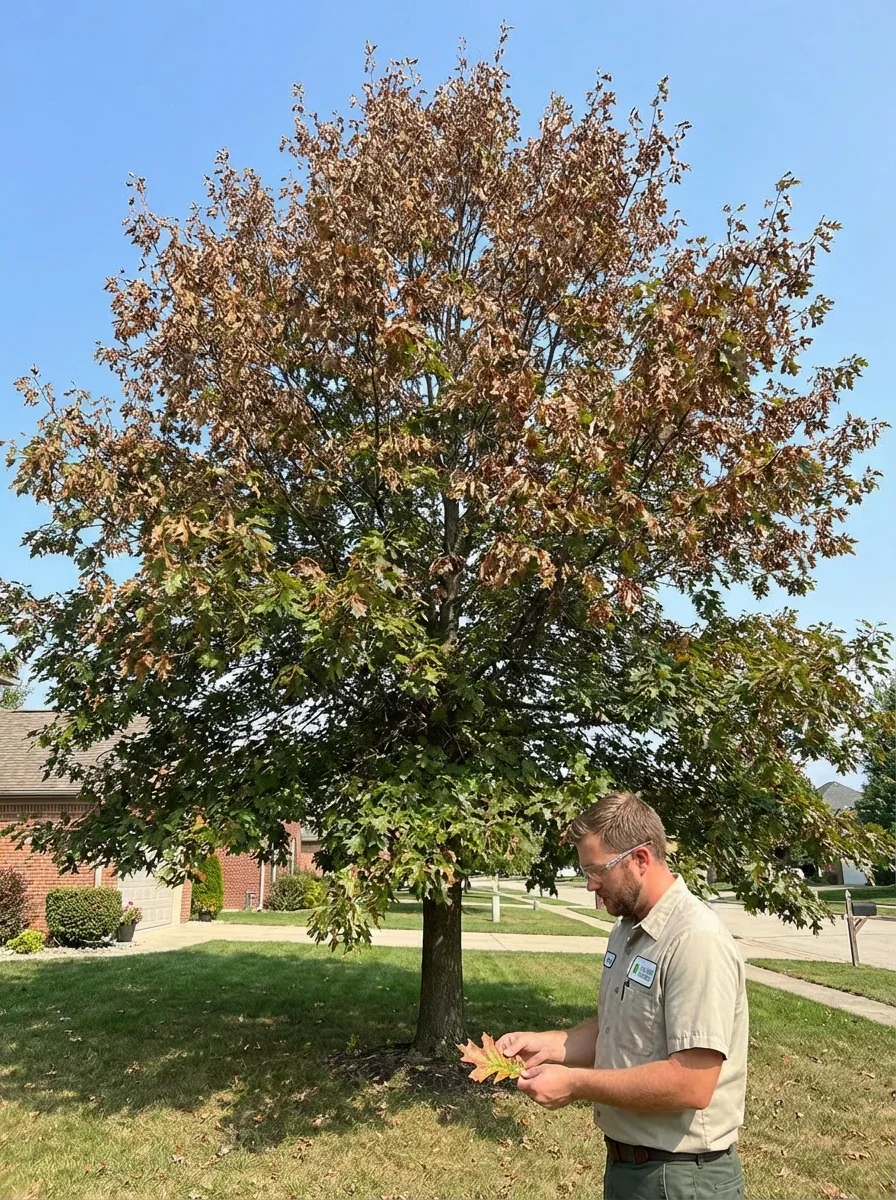
Oak Wilt Symptoms - Is Your Oak Tree Infected?
Read Problem
Ash Tree Dying? Signs of Emerald Ash Borer
Read ProblemOak Wilt Treatment vs Prevention: When to Act in Wisconsin
Read Guide