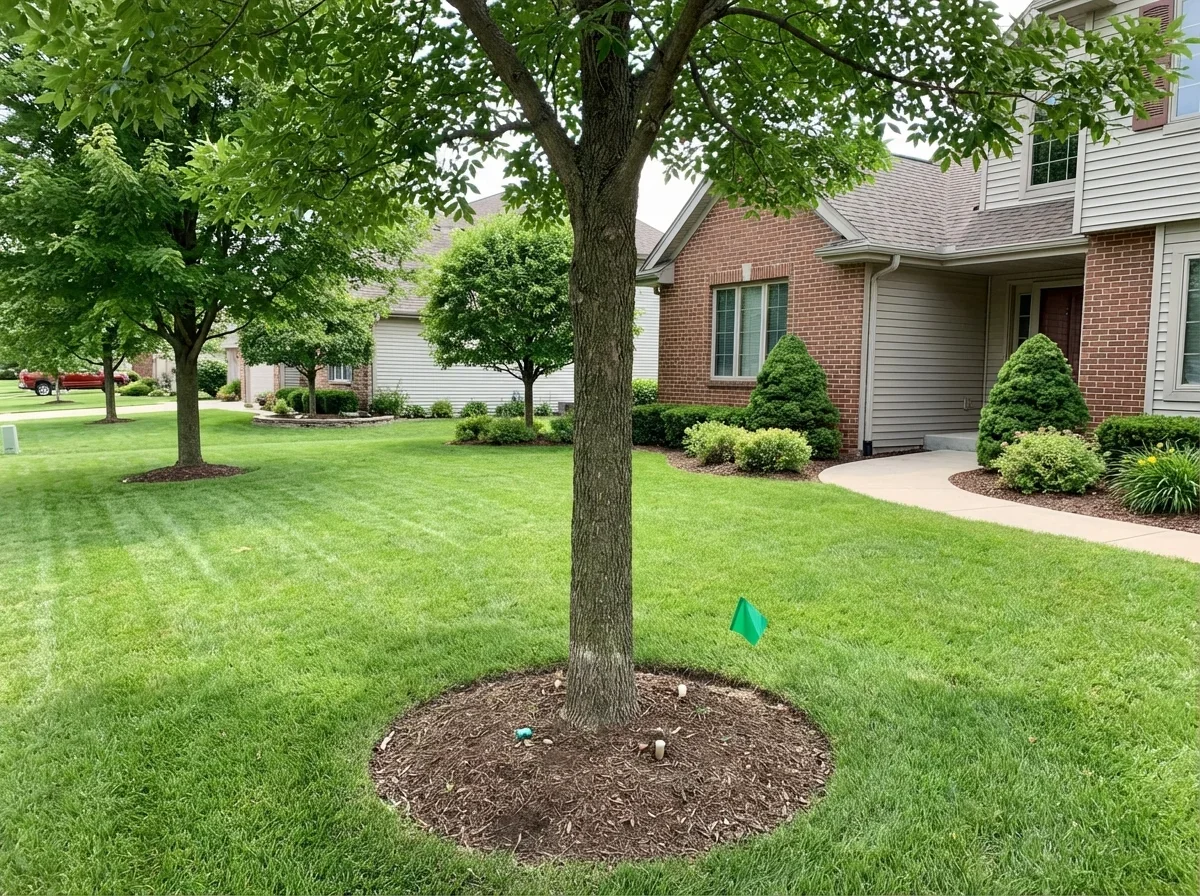
When Do You Need EAB Treatment?
Emerald Ash Borer has been in Wisconsin since 2008. The entire state is under quarantine. If you have ash trees in Appleton, Green Bay, or anywhere in the Fox Valley, the beetle is already here.
The question isn't if your trees will be attacked — it's when, and whether you'll treat them before it's too late.
Preventive Treatment for Healthy Ash Trees
The best time to treat is before you see damage. Healthy ash trees with full canopies respond to preventive treatment with 98%+ success rates. You protect the tree before larvae tunnel into the wood. No dieback. No stress. Just continuous protection.
If your ash tree looks fine right now, that's exactly when treatment works best. Once canopy loss exceeds 30%, success rates drop to 50% or less.
Signs Your Ash Tree Is Already Infested
Look for these warning signs on your property:
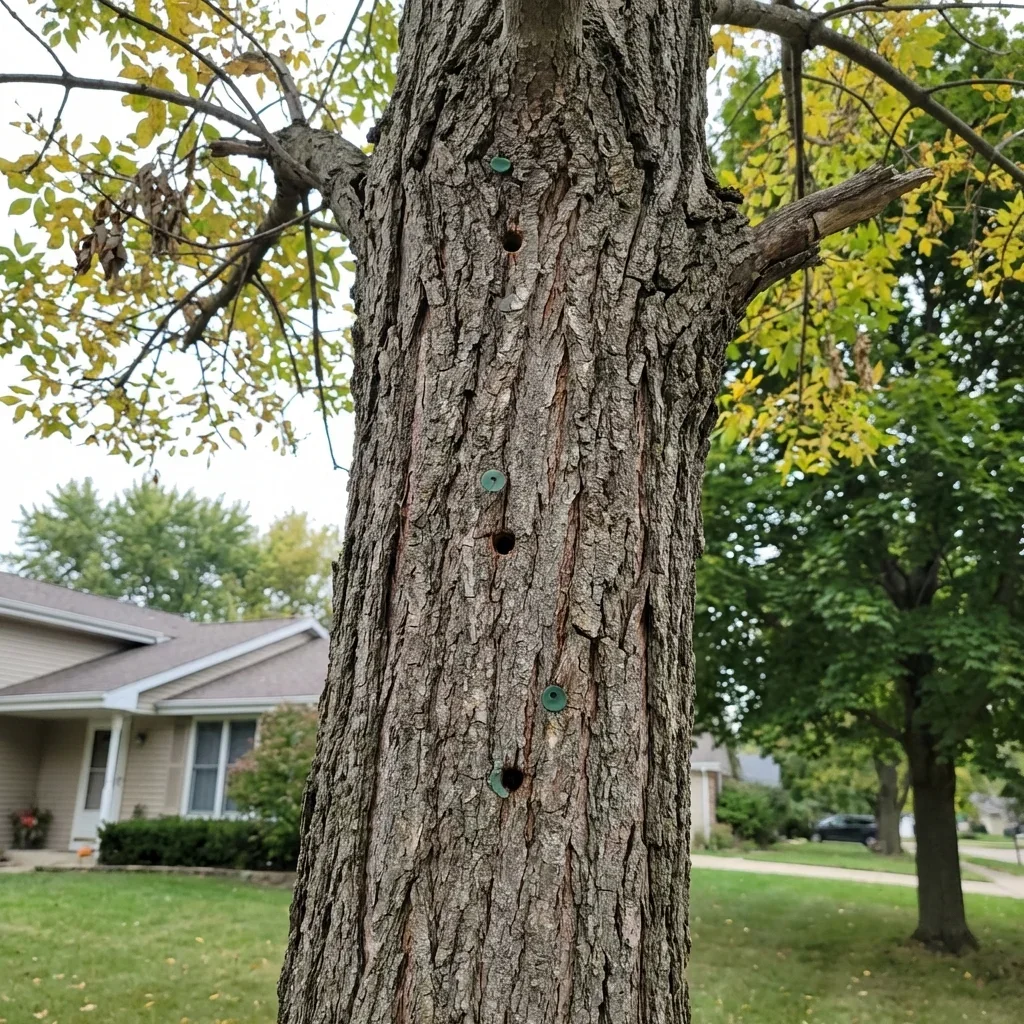
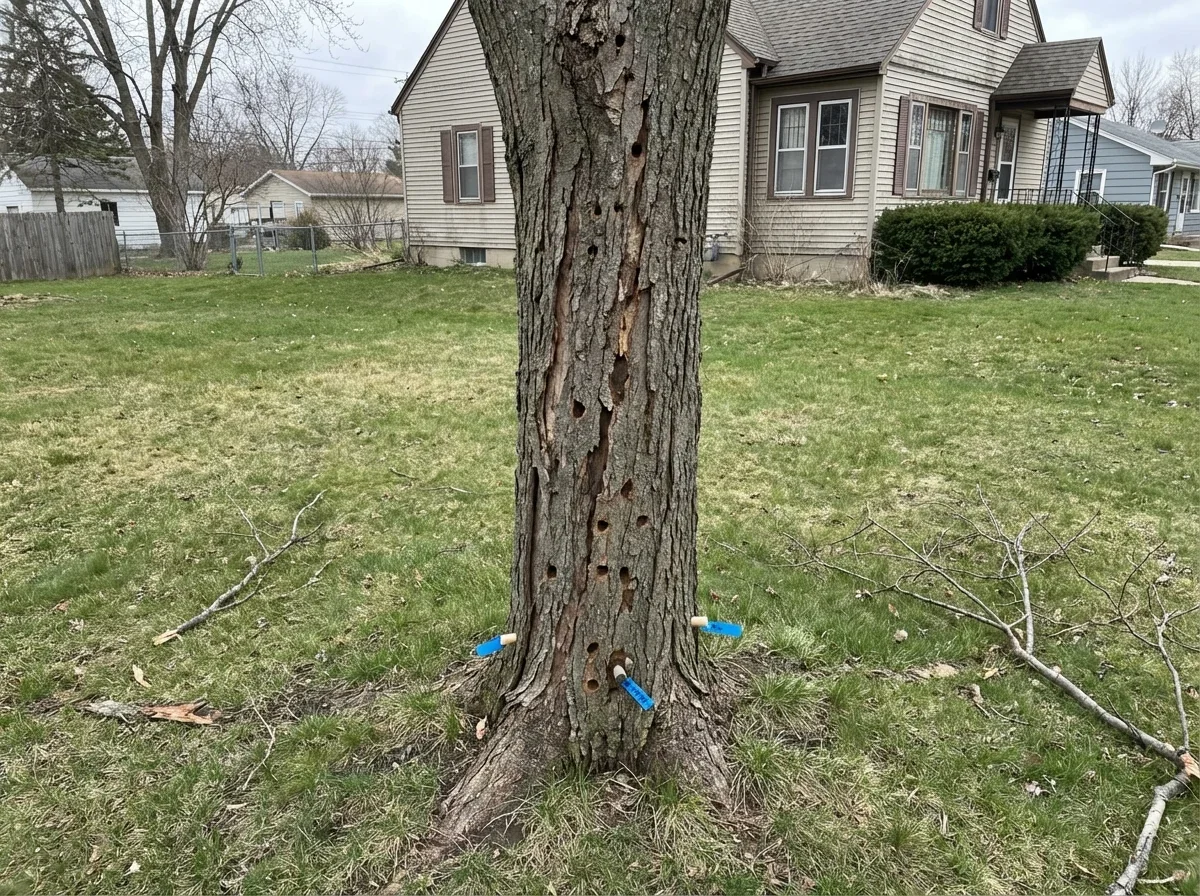
- D-shaped exit holes in the bark (3-4mm wide) where adult beetles emerged
- Serpentine galleries under the bark where larvae fed
- Canopy dieback starting at the top and outer branches
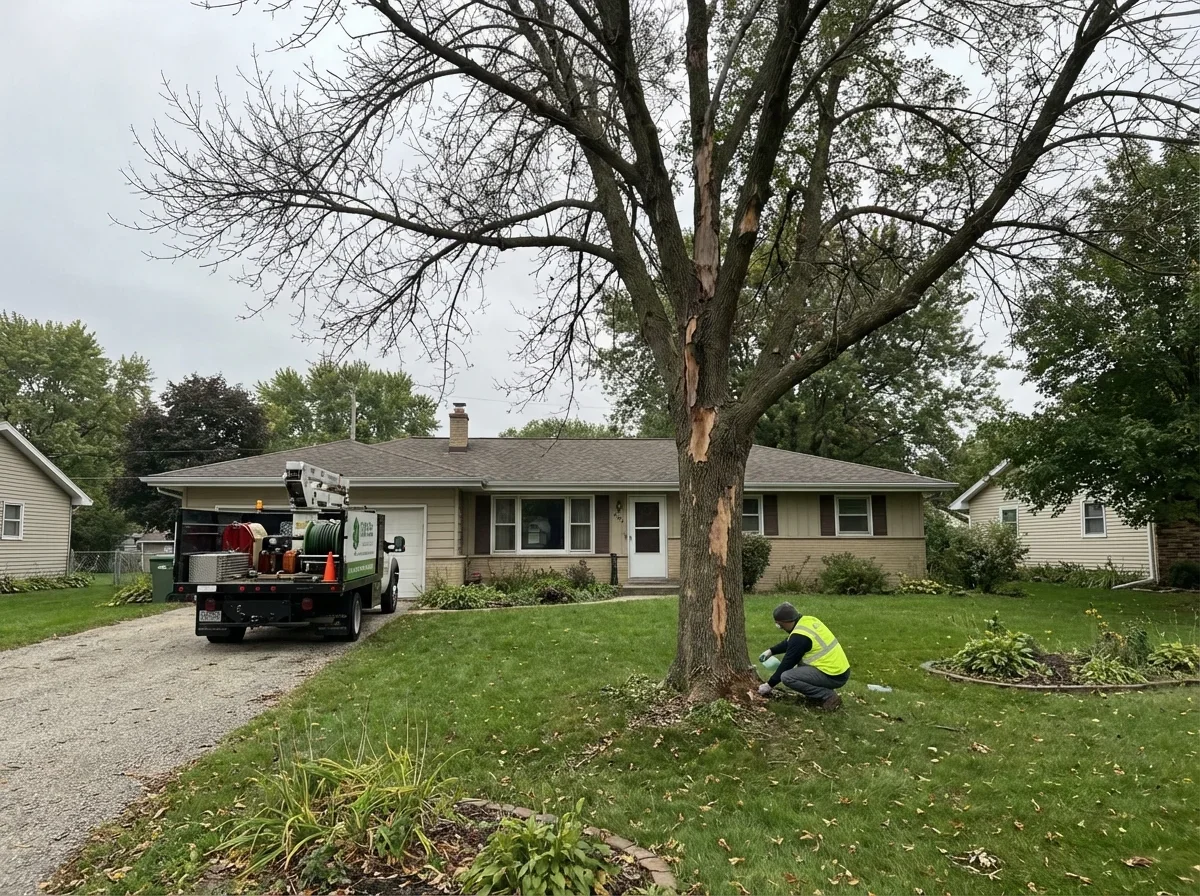
- Vertical bark splits exposing light-colored wood beneath
- Increased woodpecker activity (they feed on EAB larvae)
- Epicormic shoots (small branches) growing from the trunk
The timeline is brutal. EAB larvae feed on the cambium layer that transports water and nutrients. A heavy infestation girdles the tree within 2-3 years. Homeowners in Oshkosh and Neenah often don't notice damage until 40-50% of the canopy is already gone.
If you see exit holes, the beetles have been in your tree for at least a year. Treatment can still work if less than 30% of the canopy is dead, but you're in the curative phase now — not preventive. That means higher risk and potentially more intensive treatment protocols.
Ash trees don't recover on their own. The EAB population in an infested tree continues to grow exponentially. Without intervention, the tree dies. In urban areas like Green Bay and Kaukauna, infested trees become hazards — dead branches fall, root systems weaken, and removal costs climb as the tree deteriorates.
Timing matters. Spring and early summer are peak flight periods when adult beetles lay eggs. If you treat during the active growing season (April through September), trunk injections stop larvae before they tunnel deep into the sapwood.
What Does Emerald Ash Borer Treatment Cost in the Fox Valley?
Professional EAB treatment in the Fox Valley runs $150-$400 per application depending on tree size and treatment method. That's the number homeowners actually pay arborists in Appleton, Menasha, and throughout the region.
Here's how pricing breaks down:
Tree Size and Treatment Method
Tree diameter (measured at chest height, or DBH) determines cost. Larger trees require more insecticide and more injection points.
| Tree DBH | Trunk Injection | Soil Drench | Treatment Frequency |
|---|---|---|---|
| 6-10 inches | $150-$200 | $80-$120 | Every 2-3 years (injection) |
| 11-17 inches | $200-$300 | $120-$180 | Every 2-3 years (injection) |
| 18-25 inches | $300-$400 | $180-$250 | Annual (soil drench) |
| 26+ inches | $400-$600+ | $250-$350 | Annual (soil drench) |
Trunk injection uses emamectin benzoate (brands like Tree-äge), the most effective EAB treatment available. Licensed arborists drill small holes and inject insecticide directly into the tree's vascular system. Protection lasts 2-3 years per application. Success rate: 99% for preventive treatment.[1]
Soil drench uses imidacloprid, a systemic insecticide applied at the tree's base. The roots absorb it over several weeks. Effectiveness ranges from 85-95%, and most products require annual application. Less expensive per treatment, but frequency adds up.
Treatment Frequency and Long-Term Costs
This isn't a one-time expense. EAB pressure continues as long as untreated ash trees remain in the area. You're committing to a multi-year program.
10-year cost comparison:
| Scenario | Total Cost |
|---|---|
| Trunk injection (every 2 years, 5 treatments @ $250) | $1,250 |
| Soil drench (annual, 10 treatments @ $150) | $1,500 |
| Tree removal (mature tree) | $800-$2,000 |
| Removal + replacement tree | $1,100-$2,800 |
Treatment makes financial sense if you want to keep your ash tree. Removal eliminates the tree permanently. A 20-inch ash that took 40 years to grow costs $1,200 to remove and $600 to replace with a new 2-inch caliper tree — which won't provide shade or visual impact for another decade.
Homeowners in Appleton who treated early (before visible damage) are now 6-7 years into successful protection programs. Their trees look healthy while untreated ash trees on neighboring properties have died and been removed.[2]
The break-even calculation: If your ash tree is worth keeping for at least 5-7 years, treatment costs less than removal and replacement. If the tree is declining for other reasons (disease, storm damage, poor structure), removal might make more sense.
Most arborists in the Fox Valley offer multi-year contracts with per-treatment pricing. You're not locked in forever, but you save money by committing to 2-3 treatments upfront.
The EAB Treatment Process
Professional EAB treatment takes 30-90 minutes per tree depending on size and method. Here's what happens when a certified arborist treats your ash tree:
Trunk Injection Method
1. Tree assessment (April-September window)
The arborist measures tree diameter and inspects the canopy. Trunk injections only work when the tree is actively growing and moving water through its vascular system. In Wisconsin, that's roughly mid-April through early September. Trees treated outside this window won't distribute the insecticide effectively.
2. Injection site preparation
For a 12-inch DBH tree, the arborist drills 4-6 small holes (about 1/4 inch diameter) around the trunk at chest height. Holes are spaced evenly and angled slightly downward. Larger trees require more injection points.
3. Insecticide application
The arborist inserts a pressurized injector into each hole and delivers emamectin benzoate directly into the sapwood. The tree's xylem tissue pulls the insecticide upward into the canopy. Application takes 15-30 minutes depending on tree size.
4. Healing
The tree compartmentalizes the injection wounds within a few weeks. Small injection holes heal faster and cause less stress than older macro-injection systems that required drilling larger holes.
Protection window: Full systemic coverage within 30 days. Protects for 2-3 years.
Soil Drench Application
1. Root zone preparation (spring application preferred)
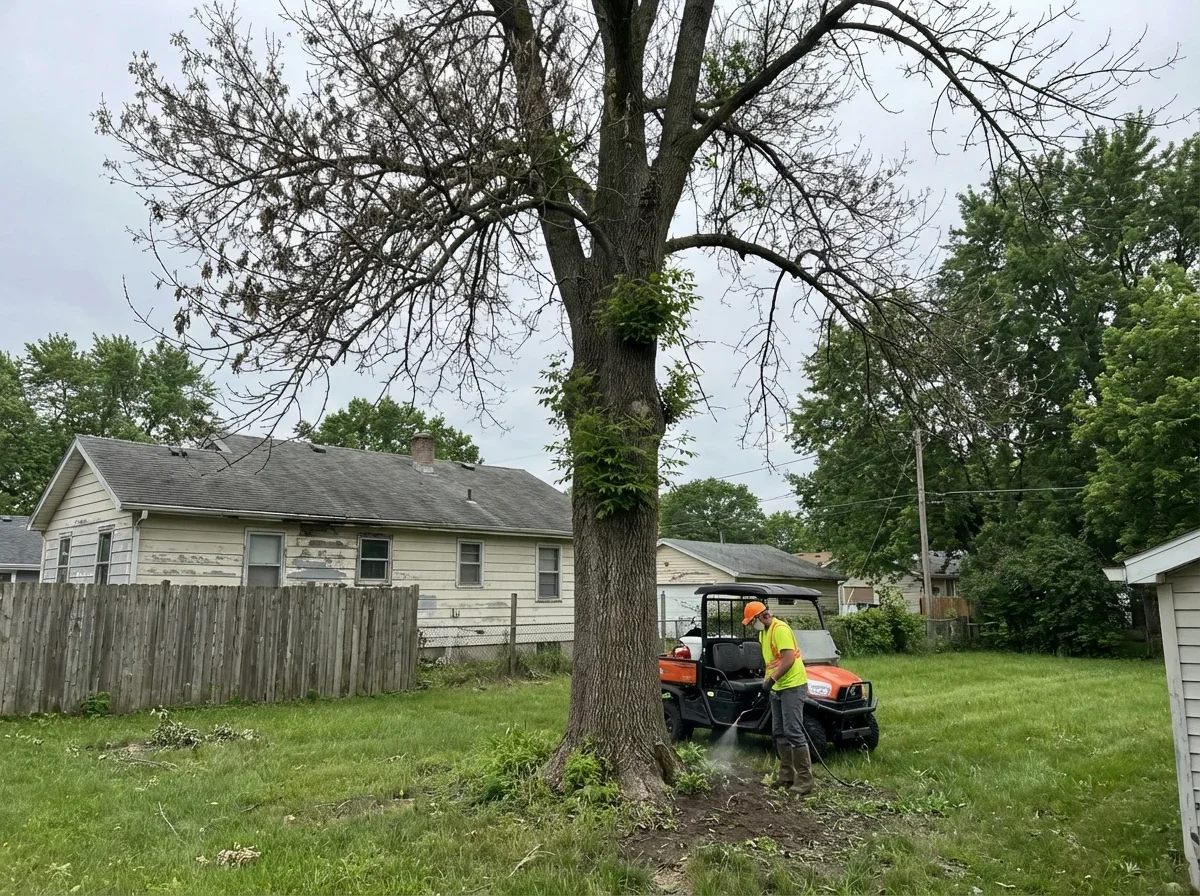
The arborist measures the tree's drip line (the outer edge of the canopy). Treatment is applied to the soil surface within 6 inches of the trunk base or injected into the soil in a grid pattern around the root zone.
2. Imidacloprid application
The arborist mixes the insecticide with water and pours or injects it into the soil. For a 10-inch tree, expect 1-2 gallons of solution. The soil must be moist for roots to absorb the chemical — which is why spring application works best in the Fox Valley (consistent rainfall, active root growth).
3. Absorption period
Roots uptake the insecticide over 4-8 weeks. The tree transports it through the vascular system to leaves and bark where EAB larvae feed.
Protection window: Full coverage by mid-summer. Requires annual reapplication.
Soil drenches work best for smaller trees (under 20 inches DBH) and preventive treatment. They're less effective once a tree is heavily infested because compromised vascular systems don't distribute the insecticide efficiently.
Seasonal timing in Wisconsin: Arborists in Oshkosh and throughout the Fox Valley typically schedule trunk injections from late May through August. Soil drenches happen in April and May. If you call in July, trunk injection is still an option. If you call in October, you'll schedule for the following spring.
Trunk Injection vs Soil Drench: Which Treatment Is Right for Your Tree?
The short answer: trunk injection with emamectin benzoate is the gold standard for EAB treatment. It's more effective, lasts longer, and works even on larger trees.
But soil drenches have their place for smaller trees and budget-conscious homeowners willing to commit to annual applications.
Choose trunk injection if:
- Your tree is over 17 inches DBH (soil drenches lose effectiveness on large trees)
- You want maximum protection (99% efficacy vs 85-95%)
- You prefer treating every 2-3 years instead of annually
- The tree is in curative treatment (already showing EAB damage)
- You're protecting a valuable specimen tree
Choose soil drench if:
- Your tree is under 15 inches DBH and healthy (preventive only)
- You're treating multiple small ash trees and want lower per-tree costs
- You're comfortable with annual applications
- You want to minimize physical impact to the tree (no drilling)
One critical limitation: The most effective EAB treatments (emamectin benzoate trunk injections) are restricted-use pesticides. Only licensed, certified applicators can purchase and apply them. DIY homeowner products exist (imidacloprid soil drenches available at garden centers), but they're less effective and still require careful application.[1]
If you're treating 3-4 ash trees, the math matters. Four 12-inch trees treated annually with soil drench ($120 each) costs $480/year. The same trees treated with trunk injection every two years ($200 each) costs $400 per treatment cycle — better protection and lower annualized cost.
Arborists in the Fox Valley often recommend trunk injection for mature ash trees that provide significant shade, privacy, or curb appeal. For younger ash trees (under 10 inches DBH) that are easy to replace, some homeowners choose removal and replanting with EAB-resistant species.
How to Choose an EAB Treatment Arborist
EAB treatment requires certification. The arborist you hire must hold a pesticide applicator license issued by the Wisconsin Department of Agriculture, Trade and Consumer Protection. This isn't optional — it's state law for restricted-use pesticides.
What to ask before you hire:
- "What's your pesticide applicator license number?" (verify at datcp.wi.gov)
- "Which treatment product do you use, and what's the protection window?"
- "What's your success rate with EAB treatment on trees with [X%] canopy loss?"
- "Do you offer multi-year treatment plans or per-application pricing?"
- "Will you assess my tree before recommending treatment, or do you automatically treat any ash?"
Red flags:
- Arborists who guarantee 100% success on trees with severe dieback (if more than 40% of the canopy is dead, no treatment is guaranteed)
- Companies that push treatment without inspecting the tree
- Prices significantly below market ($75 for trunk injection on a 20-inch tree? They're either using inferior products or under-dosing)
- "One-time treatment protects forever" claims (false — you'll need retreatment)
Reputable arborists in Neenah and throughout the Fox Valley will walk your property, assess each ash tree individually, and give you honest recommendations. Some trees are too far gone. Some are in locations where removal makes more sense than 10 years of treatment.
The best arborists also discuss alternative species. If you remove an ash tree, what should you plant instead? Swamp white oak, hackberry, and Kentucky coffeetree all thrive in Wisconsin and resist most pest problems.
Insurance and liability matter. EAB treatment involves drilling into your tree and applying chemicals. Verify the company carries general liability insurance and workers' compensation. If an arborist damages your tree, you want coverage.
Most established tree care companies in the Fox Valley offer EAB treatment as part of broader plant health care programs. You'll get better service from arborists who also prune, diagnose diseases, and manage other tree issues than from fly-by-night pesticide applicators who only treat EAB seasonally.
Frequently Asked Questions
Yes, but only if caught early. Trees infested with borers (including emerald ash borer) can be saved if:
- Detection is early — before significant canopy decline or extensive tunneling damage
- Treatment starts immediately — professional insecticide injection (Emamectin Benzoate, Tree-age, or similar) in early spring
- Tree vigor is good — stressed, declining trees are harder to save
- Follow-up care occurs — watering, mulching, and repeat treatments (often annual) as needed
Trees that are heavily infested (50%+ canopy loss, girdling, or multiple seasons of infestation) are unlikely to survive. A certified arborist can assess your tree's condition and recommend treatment or removal. Early intervention is critical—contact a local tree service as soon as you notice signs (D-shaped exit holes, bark splitting, branch dieback).
- University of Wisconsin-Madison Division of Extension. "Is My Ash Tree Worth Treating for Emerald Ash Borer?." https://hort.extension.wisc.edu/articles/my-ash-tree-worth-treating-emerald-ash-borer/. Accessed February 11, 2026.
- Wisconsin Department of Natural Resources. "Answering Common Emerald Ash Borer Yard Tree Questions." https://forestrynews.blogs.govdelivery.com/2024/11/11/answering-common-emerald-ash-borer-yard-tree-questions/. Accessed February 11, 2026.
Related Articles
How to Hire an Arborist (Checklist)
Read GuideEmerald Ash Borer Treatment Cost: Is Saving Your Ash Tree Worth It?
Read Cost Guide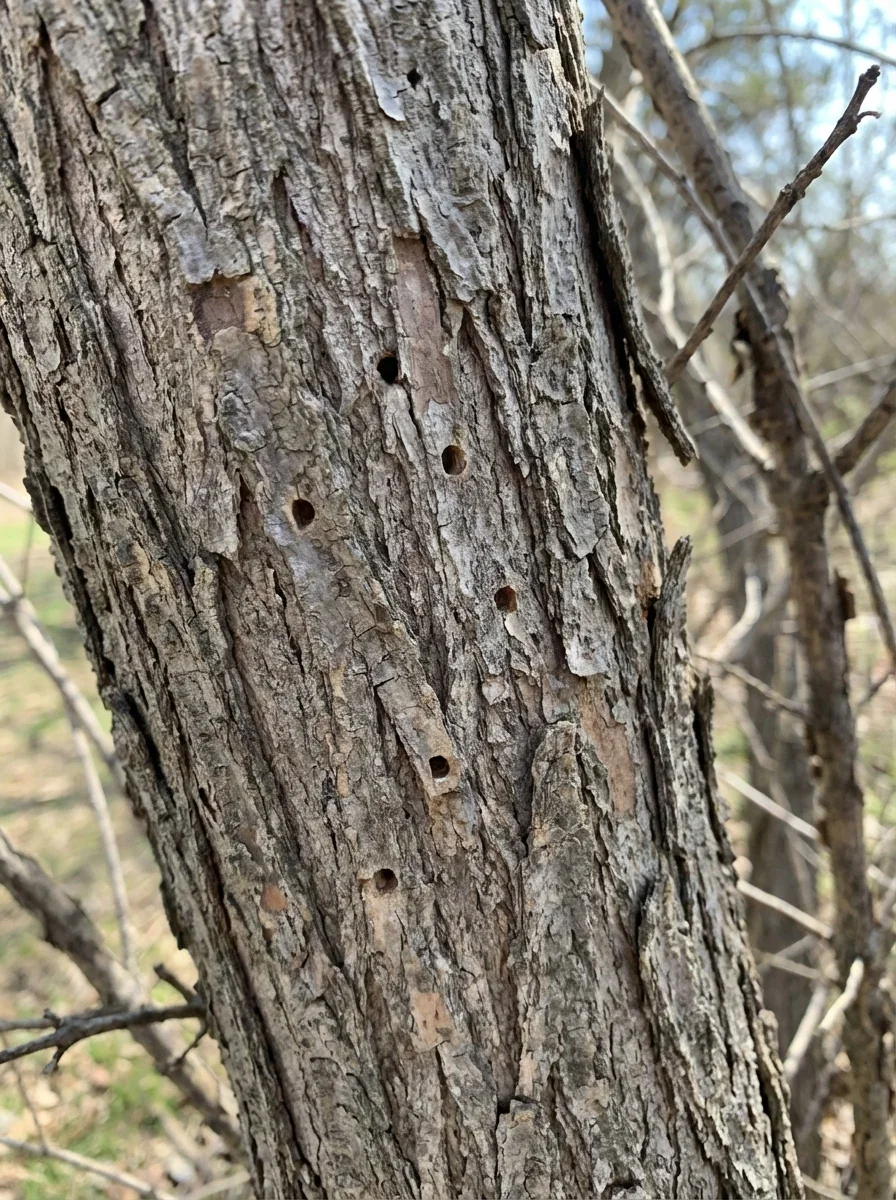
Ash Tree Dying? Signs of Emerald Ash Borer
Read ProblemEmerald Ash Borer Treatment Cost: Is Saving Your Ash Tree Worth It?
Read Guide