
How Tree Roots Actually Damage Your Foundation
Tree roots rarely break through solid concrete. Instead, they cause two types of problems that sneak up on you over months or years.
The first is moisture extraction. Roots constantly pull water from the soil around your foundation, especially during dry stretches. If you have clay soil — common across much of the Midwest — that drying causes the ground to shrink and pull away from your foundation. Your house settles unevenly into the gaps left behind, creating cracks in walls, floors, and the foundation itself.[2]
In Texas alone, this type of foundation failure costs homeowners $2 billion every year in repairs.[2]
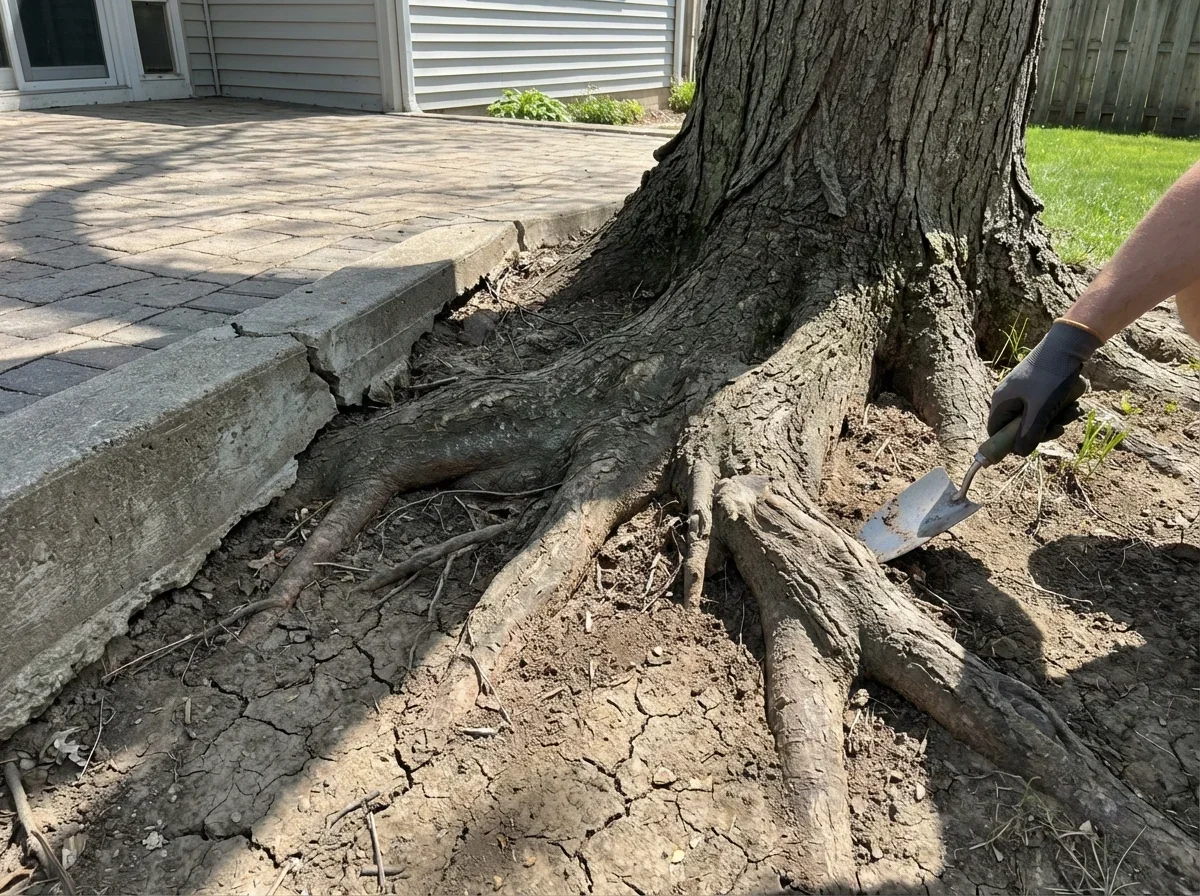
The second problem is physical displacement. Tree roots grow horizontally, spreading out in the top one to two feet of soil. When they run into something solid like your foundation footing or a sidewalk slab, they don't stop — they push. That pressure can lift concrete, widen existing cracks, and shift your foundation just enough to throw walls and door frames out of alignment.[3]
Both types of damage build slowly. You might notice a small crack one summer, then find it's doubled in size by the next spring. The roots aren't attacking your foundation — they're just doing what roots do, seeking water and growing.
But the result is the same: structural problems that get worse the longer you wait.
| Damage Type | How It Works | Primary Risk Factor | Timeline |
|---|---|---|---|
| Moisture Extraction | Roots pull water from soil, causing ground to shrink and pull away from foundation | Clay soil in dry climates | Months to years of gradual settling |
| Physical Displacement | Roots push against foundation and concrete, creating pressure | Shallow-rooted trees planted too close | Slow but progressive shifting and lifting |
What Signs Tell You Roots Are the Problem
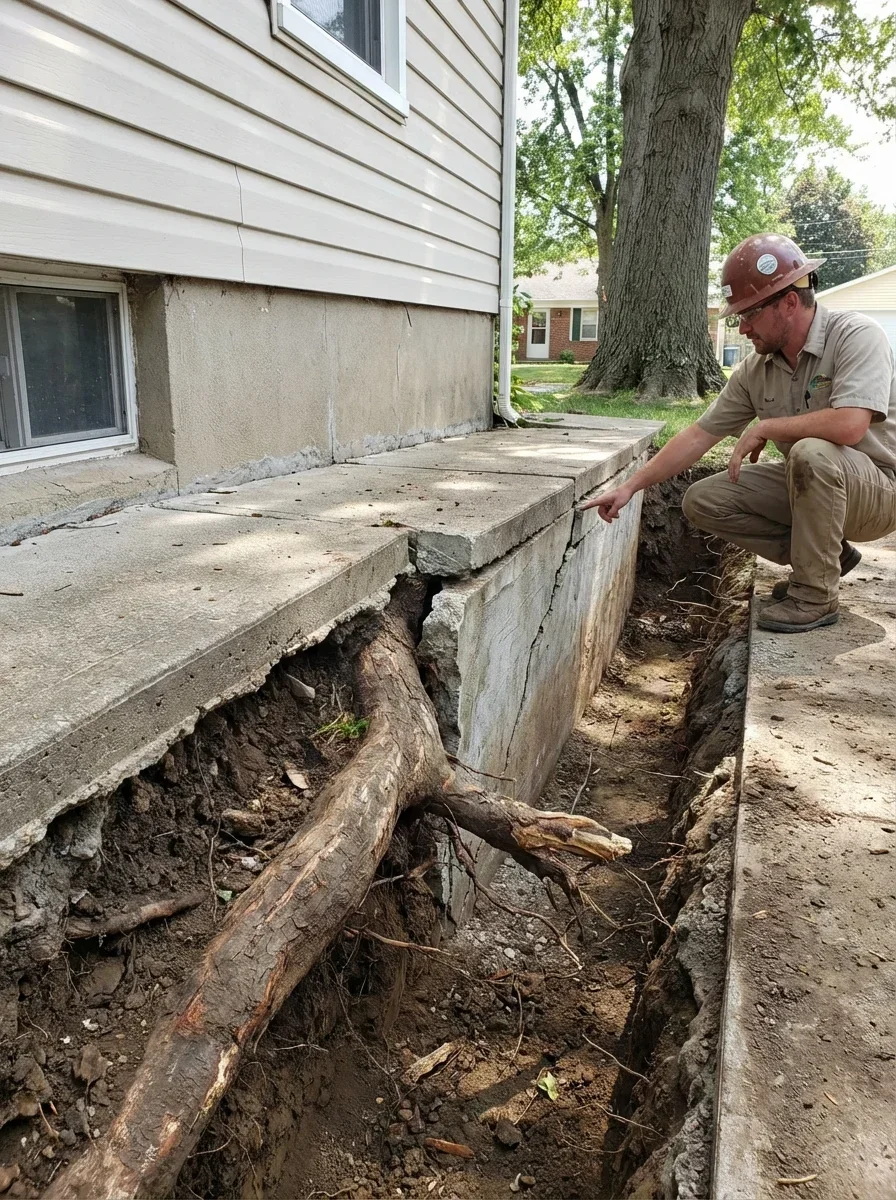
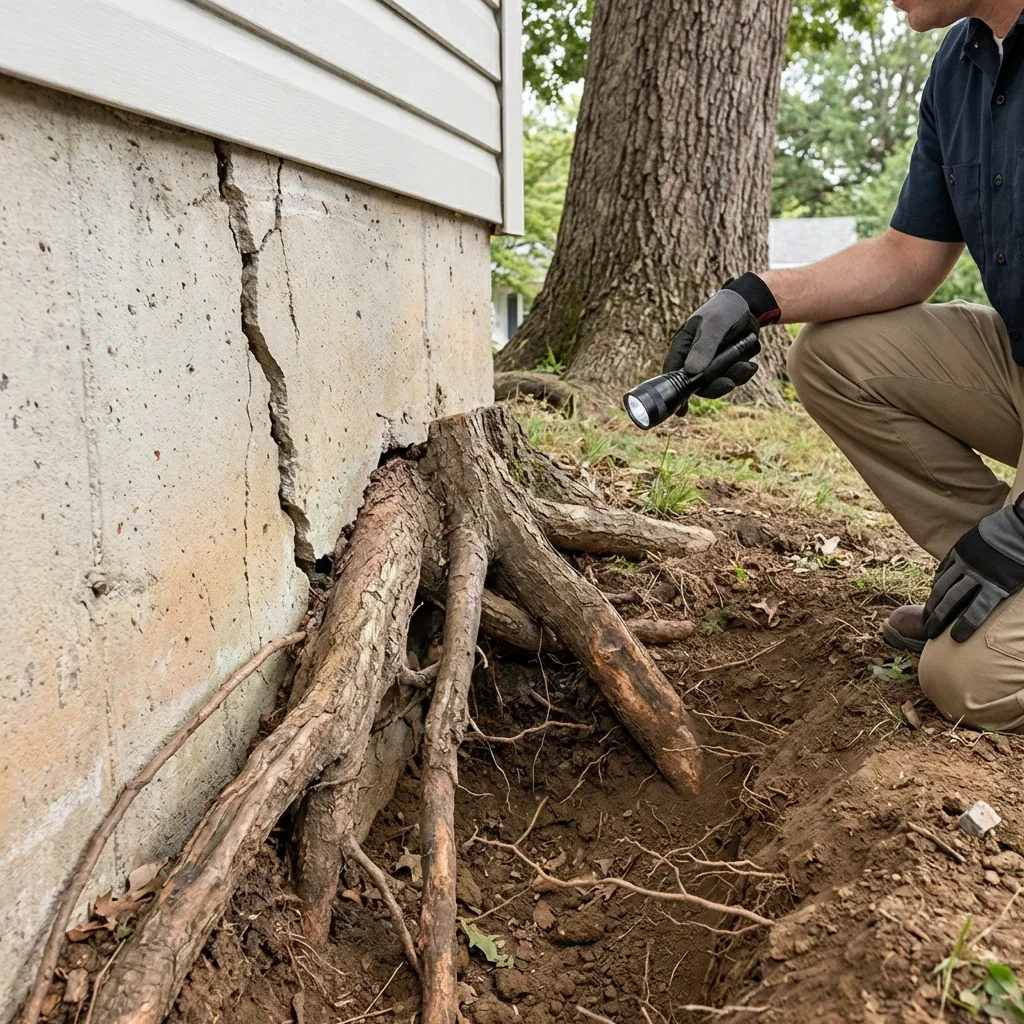
Most homeowners don't realize tree roots are causing damage until the symptoms become obvious. Cracks in your foundation walls or basement floor are the most common red flag, especially if they're widening over time or running at diagonal angles. You might also see gaps forming between your foundation and the ground around it, or notice the soil sinking near your home's perimeter.
Doors and windows that suddenly stick or won't close properly often mean your foundation has shifted. Uneven or sloping floors inside the house point to the same issue — the ground beneath your foundation isn't supporting it evenly anymore.
Outside, check your driveway and sidewalks for heaving or cracking. Those raised sections and broken slabs aren't just tripping hazards; they're early warnings that roots are pushing upward and may already be working their way toward your foundation.
Plumbing problems can signal root intrusion too. If your drains are backing up or you're dealing with persistent sewer issues, roots may have infiltrated your pipes through tiny cracks or loose joints. Once inside, they expand and create blockages that only get worse. Cities nationwide spend an average of $1.66 per tree every year repairing sewer damage caused by roots — for individual homeowners, those repairs often run much higher.[1]
Before you call a contractor, dig down about a foot or two near the area where you're seeing damage. If you find thick roots running toward your foundation or under your driveway, you've confirmed the source.
If you don't see roots, the problem might be soil conditions, poor drainage, or structural issues unrelated to trees.
Early Warning Signs of Root Damage:
- Diagonal or widening cracks in foundation walls or basement floors
- Gaps forming between foundation and surrounding soil
- Doors and windows that stick or won't close properly
- Uneven or sloping interior floors
- Heaved or cracked driveway and sidewalk sections
- Persistent sewer backups or slow drains
- Visible thick roots when digging 1-2 feet down near damage areas
Which Trees Cause the Most Damage
Not all trees pose the same risk to your property. Species with aggressive, shallow root systems are the worst offenders.
Willows, poplars, and silver maples spread their roots fast and far, often reaching 50 feet or more from the trunk. They're drawn to moisture, which makes them especially dangerous near foundations, sewer lines, and septic systems. Elms and ash trees also have invasive root systems that grow close to the surface and can lift sidewalks or driveways with surprising force.
On the other end, oaks and most conifers grow deeper, slower roots that are less likely to cause immediate problems — but even they can damage foundations if planted too close or if soil conditions shift.
The distance between your tree and your house matters more than most people expect. A general rule is to plant trees at least as far from your foundation as their mature canopy width. But roots don't stop at the drip line — they often extend two to three times wider than the branches above.
A mature oak 30 feet from your house might still have roots reaching your foundation, especially if the soil is loose or you have poorly compacted backfill around your home's perimeter.
Soil type amplifies the risk. Clay soils shrink dramatically when they dry out, creating gaps under your foundation that destabilize the structure. Sandy soils drain fast and offer less resistance to root growth, letting roots spread more easily toward your home. If you're not sure what type of soil you have, a simple soil test can tell you — and might save you from blaming the wrong tree.
Root Barriers: Do They Actually Work?
Root barriers are physical or chemical shields installed between your tree and your foundation to block root growth. Physical barriers — usually made from heavy-duty plastic, geotextile fabric, or metal — are buried vertically in a trench to redirect roots downward or away from your home.
Done right, they can protect foundations, driveways, and sewer lines without killing the tree.
But barriers aren't foolproof. Roots are persistent. If the barrier doesn't extend deep enough or doesn't create a complete wall, roots will find a way around or under it. Most effective barriers go down at least 18 to 24 inches and extend several feet past the problem area in both directions. Some arborists recommend barriers that angle outward at the bottom to force roots deeper into the soil rather than simply redirecting them horizontally.
Chemical root barriers use herbicides or growth inhibitors to create a zone where roots won't grow. They're less invasive to install than physical barriers, but they need reapplication over time and can harm beneficial soil organisms.
They're also less reliable if you have fast-growing, aggressive tree species.
Barriers work best when installed early — before roots have already infiltrated cracks or pushed under your foundation. If you're seeing advanced damage like wide foundation cracks or severe driveway heaving, a barrier alone probably won't fix the problem. You'll need to cut back the offending roots first, repair the damage, and then install the barrier to prevent regrowth.
Cutting roots too close to the trunk can destabilize or kill the tree, so this is where you need an arborist who understands both tree health and structural protection.
Pro Tip: Root barriers only work if installed before major damage occurs. Once roots have already infiltrated foundation cracks or caused significant settling, you'll need to cut back roots and repair damage first — the barrier just prevents regrowth. Installing a barrier on an already-compromised foundation is like locking the door after the break-in.
When to Remove the Tree Instead
Sometimes keeping the tree isn't worth the risk. If roots have already worked their way into foundation cracks or caused significant structural shifting, a barrier won't reverse the damage — it'll just slow down future problems.
Aggressive species like willows or silver maples near your foundation are hard to control long-term, even with barriers, because their roots grow so fast and spread so far.
Removal makes sense if your foundation has active cracks that are widening, if your doors and windows are visibly out of square, or if you're dealing with recurring sewer line backups caused by root intrusion. These aren't cosmetic issues — they're structural problems that will cost more to fix the longer you wait. Repairing foundation damage and then leaving the tree in place just invites the same cycle to start again.[1]
One risk people don't always consider: removing a large tree can temporarily destabilize the soil around your foundation. When you pull out a massive root system, you're left with voids where the roots used to be. If those voids collapse or fill with water, you can end up with settlement issues that mirror the damage the tree was causing.
The solution is to fill those voids carefully during removal and monitor your foundation for a full year afterward. In some cases, you might need to water the soil around your foundation more frequently after tree removal to prevent it from shrinking too much.
If you're on the fence, get a soil test and a professional assessment from a certified arborist. They can tell you whether your soil type makes future damage likely, how close the roots are to critical areas, and whether the tree's health and growth pattern justify the ongoing risk.
Sometimes the answer is clear — other times it's a judgment call based on how much you value the tree versus how much you're willing to spend managing it.
What It Costs to Fix Root Damage
Foundation repairs aren't cheap. Minor crack repairs might run a few hundred dollars if you catch them early, but once roots have caused significant settling or structural movement, you're looking at foundation underpinning, pier installation, or slab leveling — repairs that often start at $5,000 and can climb past $20,000 depending on the severity.[1]
Sidewalk and driveway repairs are more manageable but still add up. Replacing a heaved section of concrete driveway typically costs $500 to $1,500, while sidewalk repairs run $300 to $800 per section. If you're dealing with multiple areas, the costs multiply fast.
Cities spend an average of $3 per tree annually on sidewalk repairs caused by roots — that's citywide maintenance, not one-time fixes.[1]
Sewer line repairs can be the most expensive surprise. If roots have infiltrated your pipes, you might need a sewer line camera inspection ($200 to $500), hydro-jetting to clear the roots ($300 to $600), or in severe cases, pipe replacement or relining ($3,000 to $10,000 or more).
Once roots are inside your sewer line, they'll keep coming back unless you remove the tree or install a root barrier between the tree and the pipe.
Tree removal itself costs $500 to $2,000 for most residential trees, depending on size and complexity. Add in stump grinding ($100 to $400) and you're looking at a full removal project in the $1,000 to $3,000 range. Root barrier installation runs $500 to $2,000 depending on length and depth.
If you're comparing costs, factor in the ongoing risk: spending $2,000 to remove a problem tree now might save you $10,000 in foundation repairs later.
Some homeowners insurance policies cover foundation damage from roots, but many don't — or they cover it only under specific conditions. Check your policy before assuming you're protected. If the tree is on an HOA or municipal property line, you might have a liability claim, but those disputes take time and often require documentation that the tree was the cause.
How to Prevent Root Damage Before It Starts
The easiest fix is not planting problem trees near your house in the first place. Keep fast-growing, shallow-rooted species like willows, poplars, and silver maples at least 50 feet from your foundation, driveway, and sewer lines.
Slower-growing trees with deeper roots — like oaks, hickories, or most conifers — can be planted closer, but aim for a distance equal to their mature canopy width at minimum.
If you're moving into a home with mature trees already in place, get a professional inspection before problems start. An arborist can assess root spread, proximity to your foundation, and soil conditions to give you a realistic picture of future risk. They can also install preventive root barriers if the tree is worth saving but positioned too close for comfort.
Water management makes a huge difference, especially if you have clay soil. During droughts, water the soil around your foundation to keep it from shrinking and cracking. That reduces the gaps where roots can infiltrate and minimizes the soil movement that leads to settling.
Consistent moisture levels also discourage roots from seeking water near your foundation in the first place.
Monitor your property for early warning signs: small cracks in concrete, doors that start sticking, or sewer drains that slow down. Catching root damage when it's still minor gives you more options and costs far less to fix. If you see roots surfacing near your driveway or foundation, don't wait — dig down to see how close they are and consider pruning them back before they cause structural issues.
Pruning roots more than a few feet from the trunk won't harm most mature trees, but always consult an arborist to be sure.
Finding the Right Professional Help
Not every tree service has experience diagnosing and fixing root damage to structures. You need a certified arborist who understands both tree biology and how roots interact with foundations, driveways, and underground utilities.
Look for credentials from the International Society of Arboriculture (ISA) and ask specifically about their experience with root barriers and structural damage assessments.
In the Fox Valley area, soil conditions and regional tree species create specific challenges. A local arborist who's dealt with expansive clay soils and mature elms or maples will give you better advice than someone applying generic solutions. They should offer to inspect the root system, test your soil if needed, and explain whether barriers, pruning, or removal makes the most sense for your situation.
If your foundation has already cracked or settled, bring in a structural engineer or foundation repair specialist alongside the arborist. They'll confirm whether roots are the primary cause or if other issues like poor drainage or soil compaction are contributing.
Sometimes the tree is just one piece of a larger problem, and you'll need to address grading, drainage, or foundation waterproofing at the same time.
Get multiple opinions and written estimates before committing to removal or major repairs. A second arborist might see options the first one didn't, or confirm that removal really is your best path forward.
If the tree is on a property line or in an HOA common area, clarify liability and maintenance responsibility before you pay for anything — you might have a claim that shifts some or all of the cost to the responsible party.
Frequently Asked Questions
- Michigan State University Extension. "Reducing damage caused by tree roots." https://www.canr.msu.edu/news/reducing_damage_caused_by_tree_roots. Accessed February 09, 2026.
- University of Texas at Arlington Honors Research. "Tree Root Influence on Building Foundations in Expansive Soils." https://mavmatrix.uta.edu/cgi/viewcontent.cgi?article=1005&context=honors_fall2022. Accessed February 09, 2026.
- American Society of Civil Engineers (ASCE). "Damage of Structures due to Tree Roots." https://ascelibrary.org/doi/10.1061/(ASCE)0887-3828(1991)5:3(200). Accessed February 09, 2026.