
How Much Lean Is Too Much?
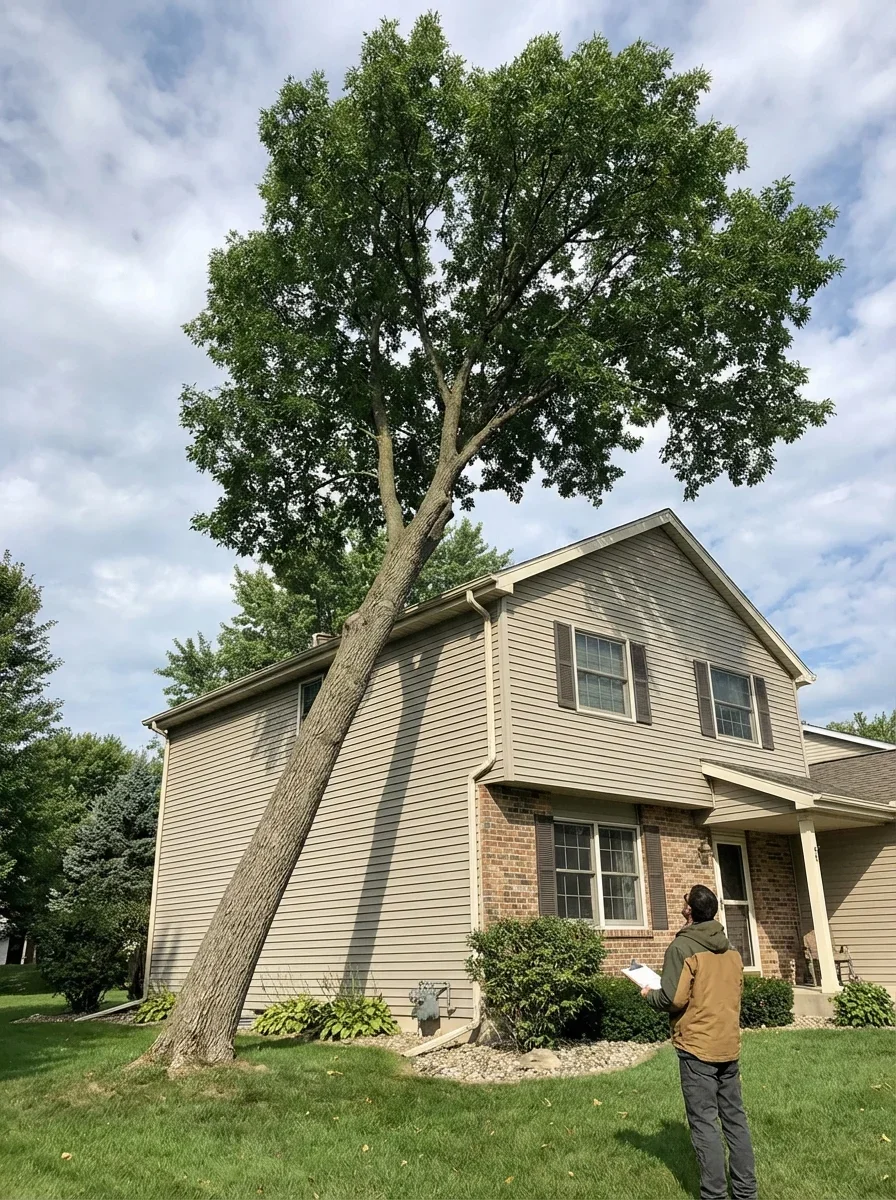
Not every leaning tree is an emergency, but any tree angled more than 15 degrees toward your house needs immediate professional assessment.[1] That's roughly the angle where the tree's center of gravity shifts enough that its root system can no longer reliably hold it upright during wind or heavy rain.
If the lean developed suddenly — after a storm, during a wet season, or following construction nearby — that's a red flag for root failure. Trees that tilt gradually over years may have adapted somewhat, but sudden changes mean the tree is actively losing its grip on the ground.
By the time you can see a lean this severe, structural damage has already happened below the surface.
Stand back and eyeball the trunk from the base to the crown. If the top third is leaning noticeably more than the bottom, or if the whole tree appears to bow in one direction, you're past the point where waiting makes sense.
Critical Threshold: A 15-degree lean is roughly equivalent to the tree moving 3 feet horizontally for every 10 feet of height. On a 40-foot tree, that's a 12-foot deviation from vertical — easily visible from across your yard.
Warning Signs That Demand Immediate Action
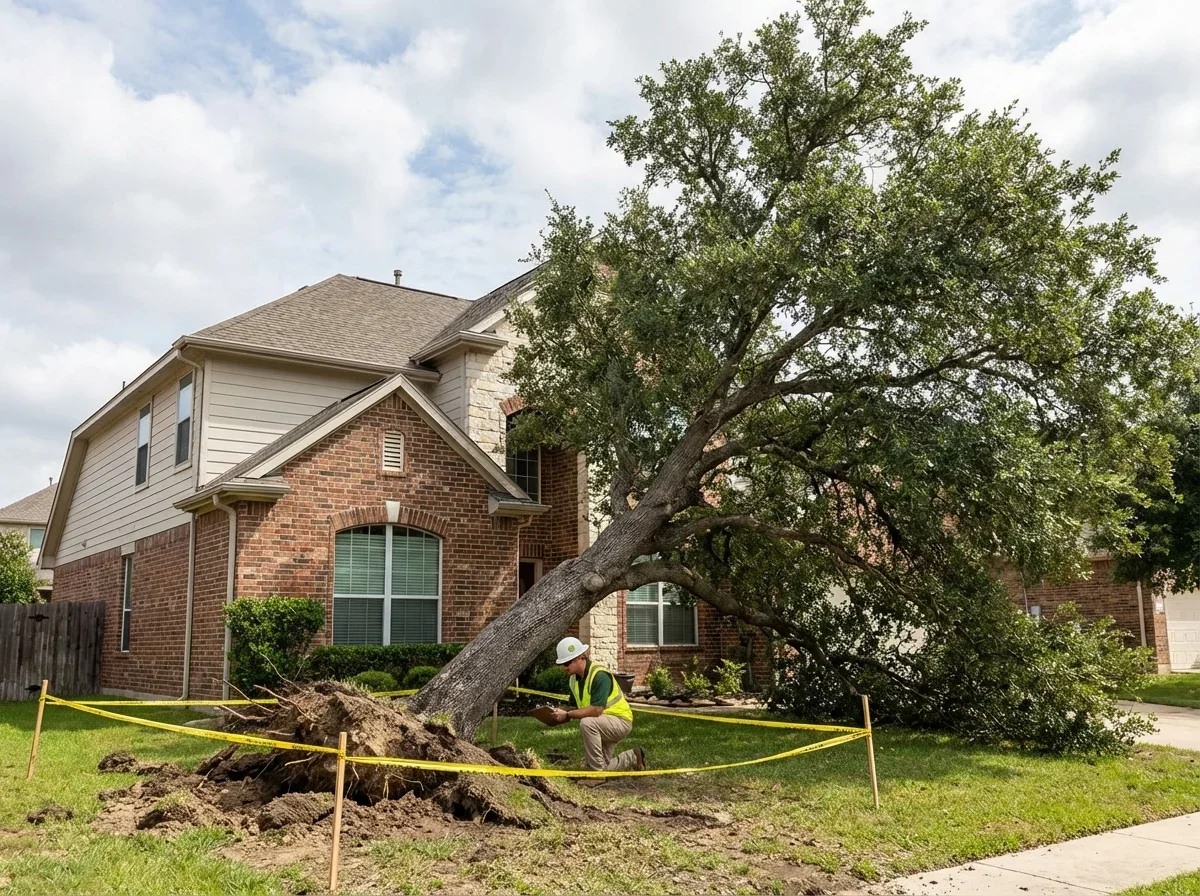
Walk around the base of the tree and look for raised soil or exposed roots on the side opposite the lean. This is the clearest signal that root failure has occurred — the tree is literally pulling its anchor out of the ground.[1] You may see a small ridge or lifted dirt, sometimes with cracks radiating outward.
That's the tree's root plate beginning to fail.
Check the trunk itself for cracks, splits, or areas where bark has separated from the wood. These gaps often appear on the side the tree is leaning toward, where tension is pulling the trunk apart. Dead branches in the crown, especially concentrated on one side, suggest the tree is under severe stress and may have already started dying from the roots up.
Look at the ground around your foundation. Are there new cracks in your basement wall? Is the soil near the house settling or bulging? Large roots don't just hold trees upright — they can lift foundations, crack slabs, and invade sewer lines. A tree falling on your house is dramatic, but root damage can cost just as much and happens silently over months.
Emergency Red Flags Requiring Same-Day Assessment:
- Soil mounding or cracking on the side opposite the lean
- Fresh cracks in the trunk wider than 1/4 inch
- Sudden lean development after a storm (within 48 hours)
- Exposed roots showing torn or broken wood
- Tree actively creaking or making popping sounds
- Visible gap between roots and soil at the base
Why Trees Start Leaning Toward Houses
Most leans develop because something changed the tree's balance or compromised its roots. Root damage is the leading cause — whether from construction that severed major roots, soil erosion that exposed them, or prolonged drought that caused the root ball to shrink and loosen.[2]
Poor planting practices set trees up for failure decades later. Trees planted too deep, in compacted soil, or too close to structures never develop the anchoring root system they need. As they grow taller and heavier, the inadequate roots can't keep up.
You'll often see this with fast-growing species like poplars or willows that were planted for quick shade without considering their shallow, unstable root systems.
Weight distribution matters too. If the canopy is heavier on the side facing your house — maybe because that's where it gets the most sun — the tree naturally leans that direction. Add a wet spring that softens the soil, and gravity takes over. Storm damage that removes branches from one side can also shift the balance, leaving the tree top-heavy in the wrong direction.
Can a Leaning Tree Be Saved?
Small trees with minor leans can sometimes be staked and encouraged to grow upright again. But large trees with torn roots are typically not practical to right and require removal to eliminate the risk.[2]
Once a mature tree has shifted past 15-20 degrees, the structural damage to the root system is usually too extensive to repair.
Cabling and bracing can stabilize certain trees if the trunk is sound and the roots are mostly intact. An arborist installs steel cables between major limbs or anchors the trunk to reduce movement. This doesn't fix the underlying problem — it just keeps the tree from falling while you decide what to do long-term. It's expensive, requires ongoing inspection, and works best for trees with sentimental or landscape value that justify the cost.
Removing weight from the canopy by pruning overhanging branches can reduce the leverage pulling the tree toward your house. But pruning alone won't save a tree that's lost root stability.
It buys you time and reduces immediate risk, but it's not a permanent solution if the tree continues to lean.
Think of it as triage while you arrange for assessment and likely removal.
| Solution | Best For | Typical Cost | Success Rate |
|---|---|---|---|
| Staking | Young trees under 15 ft with <10° lean | $150-400 | 70-80% if caught early |
| Cabling/Bracing | Mature trees, sound trunk, minimal root damage | $800-2,500 | 40-60% (requires ongoing maintenance) |
| Crown Reduction | Temporary risk reduction while planning removal | $400-1,200 | Buys 3-12 months, not permanent |
| Removal | Trees >15° lean, root failure, proximity to structures | $1,500-5,000 | 100% risk elimination |
What Happens If You Wait
The biggest risk isn't that the tree will fall on a calm Tuesday afternoon — it's that a storm will push it over when you least expect it. Wind loads increase exponentially as trees lean farther, and saturated soil after heavy rain loses the friction that holds roots in place. Trees that stood for months after developing a lean often fail during weather events that wouldn't have threatened a healthy tree.
Even if the tree doesn't fall, branches overhanging your roof cause hidden damage. They rub shingles during wind, scrape siding, drop debris into gutters, and create moisture problems that lead to rot and leaks. Squirrels and raccoons use those branches as highways to your attic.
The slow grind of branch-on-roof contact costs more over time than you'd think, and it's nearly impossible to keep up with the maintenance.
Your insurance company may not cover damage if they determine you ignored an obvious hazard. Adjusters look for signs of deferred maintenance, and a severely leaning tree pointed at your house qualifies. If the tree falls and they find photos from months earlier showing the same lean, they can deny your claim on grounds of negligence.
That turns a covered loss into a total financial disaster.
Getting a Professional Assessment
Contact an ISA-certified arborist as soon as you notice the lean. Not a tree service that showed up with a door hanger, and not your lawn guy's cousin who "does trees." Certified arborists are trained to evaluate structural stability and recognize failure patterns that aren't obvious to untrained eyes.[3]
The arborist will inspect the root plate, check for decay in the trunk, assess the canopy structure, and measure the lean angle precisely. They may probe the soil around the roots or use specialized tools to detect internal rot.
This assessment typically costs $150-300 and gives you documentation of the tree's condition — critical if you need to file insurance claims or justify removal to a homeowners association.
Ask about the timeline. If the arborist says the tree needs to come down, ask whether it's a "schedule it this month" situation or a "we need to do this immediately" emergency. Some trees are stable enough for a planned removal; others require emergency service before the next storm. Don't try to save money by delaying if the professional tells you the risk is high.
Emergency Steps Before the Arborist Arrives
Keep people and pets away from the area under and around the tree. The strike zone if the tree falls isn't just directly below — it includes everywhere the crown could reach, which is usually the full height of the tree in any direction.
Mark off this zone if you have kids who play in the yard.
If branches are already touching your house, you can carefully trim small ones that are actively rubbing or threatening windows. Don't climb the tree or use a chainsaw on anything larger than you can reach from the ground with hand pruners. Even minor cuts on a stressed tree can shift its balance unpredictably.[3]
Clear gutters and move anything valuable out of potential fall zones — cars, grills, patio furniture, play equipment. If the tree goes over tonight, you want to minimize the damage. Take photos from multiple angles showing the lean, any root exposure, and the tree's proximity to your house.
These document the timeline if you need them for insurance or disputes with contractors.
Cost and Timeline for Removal
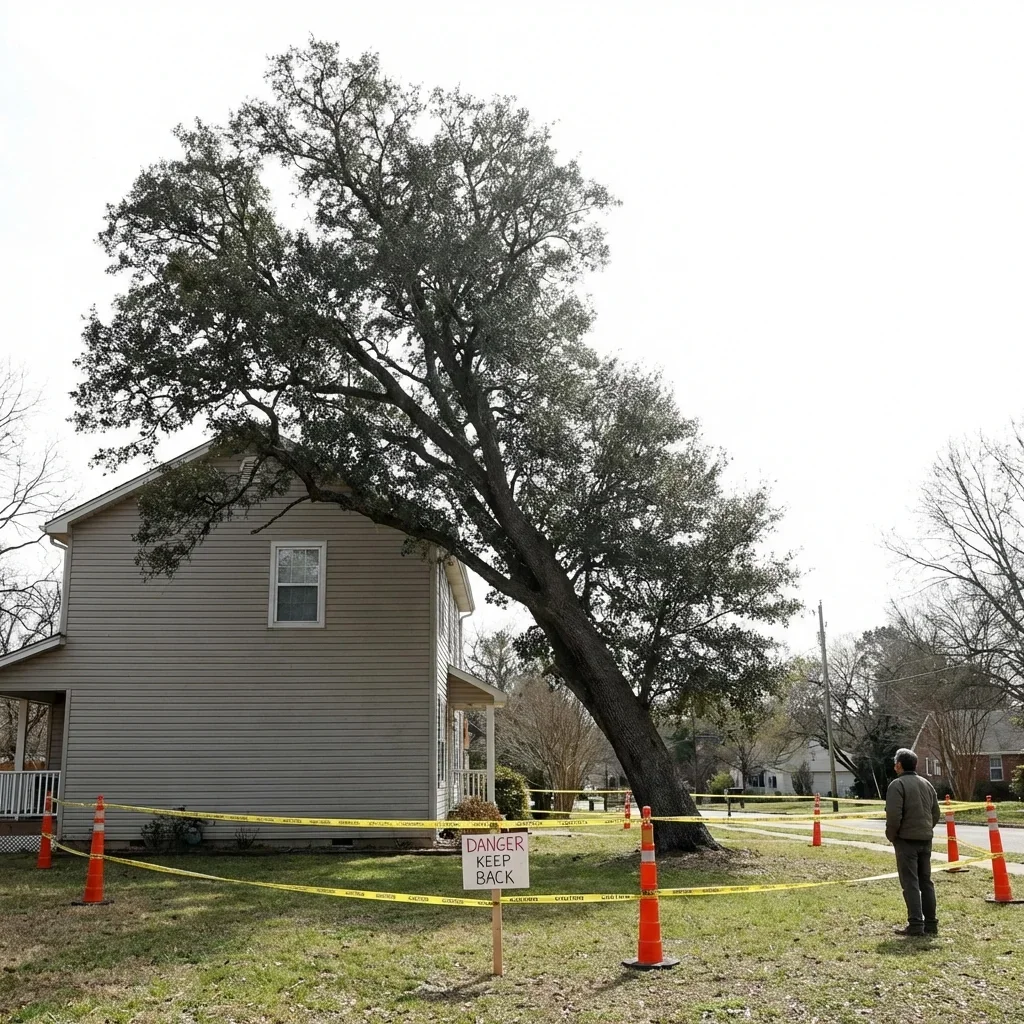
Removing a large tree leaning toward a house typically runs $1,500-5,000 depending on height, access, and how close the tree is to structures. Trees that require crane work or careful rigging to avoid hitting your house cost more than straightforward removals.
Emergency service adds 50-100% to the base price, but that's often necessary when the tree poses imminent risk.
Most removals take one to two days for a crew to complete. They'll section the tree down in pieces, lower each cut carefully to avoid damage, grind the stump, and haul away debris. Expect some minor lawn damage from equipment — larger jobs require boom trucks or cranes that leave ruts even when crews try to protect the turf.
Some homeowners insurance policies cover removal if the tree damaged the house or is imminently threatening it. They typically won't pay for removal of a dead or dying tree that hasn't fallen yet, but a documented lean combined with root failure sometimes qualifies.
Call your agent before you hire anyone — if coverage applies, they may require specific documentation or want to send their own adjuster first.
Why DIY Tree Removal Is a Terrible Idea
Homeowners die every year trying to remove trees themselves. The forces involved are massive and unpredictable — a tree that looks like it will fall away from the house can twist mid-cut and crush you, your car, or your home. Site assessments must identify hazards including tree lean and nearby buildings before beginning any tree work,[3] and professionals spend years learning to predict how trees will behave when cut.
Even if you have a chainsaw and think you know which way the tree will fall, a leaning tree has internal stresses you can't see. The wood may be under tension or compression that causes it to split violently when cut.
Branches can "barber chair" — split vertically up the trunk faster than you can run — or the whole tree can kick backward off the stump.
Both scenarios are often fatal.
Your homeowners insurance likely won't cover damage you cause attempting your own tree work, and your health insurance will scrutinize claims for injuries sustained during activities they consider reckless. Professional tree services carry liability insurance specifically for this work.
The cost of hiring them is always less than a hospital stay, a crushed vehicle, or a collapsed roof.
Frequently Asked Questions
- New York State Department of Environmental Conservation (NYSDEC). "Managing Risk In Urban Trees." https://dec.ny.gov/nature/forests-trees/urban-and-community-forestry/managing-risk-in-urban-trees. Accessed February 09, 2026.
- Penn State Extension. "What to Do About Leaning Trees." https://extension.psu.edu/what-to-do-about-leaning-trees/. Accessed February 09, 2026.
- OSHA Online Center. "OSHA Tree Trimming Safety: How to Trim Trees Safely." https://blog.oshaonlinecenter.com/osha-tree-trimming-safety-guide/. Accessed February 09, 2026.