
Sparse or Discolored Leaves
Healthy trees should have a full canopy of green, expanded leaves during the growing season without stunting or wrinkling.[1] When you notice significant bare patches or leaves that look smaller, yellowed, or wilted compared to previous years, your tree is signaling distress.
Early-season leaf problems often point to root issues or nutrient deficiencies. If only one section of the tree shows sparse foliage while the rest looks normal, that particular branch system may be dying back.
Trees under stress will sometimes drop leaves early as a survival mechanism, redirecting resources to healthier parts.
Don't confuse natural seasonal changes with health problems, though. Deciduous trees drop leaves every fall, and some trees like oaks naturally hold dead leaves through winter. The concern is when leaf problems happen during the active growing season or worsen year over year.
Dead or Dying Branches
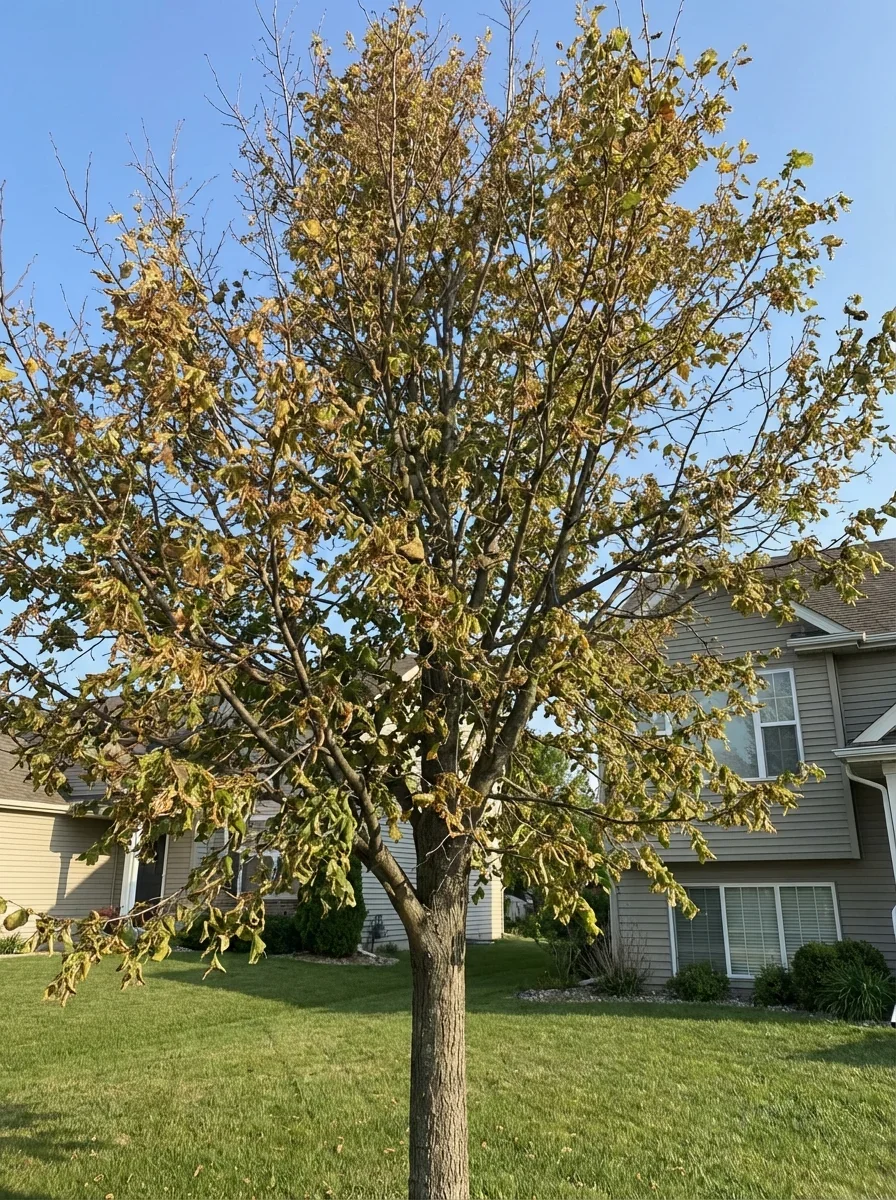
Dead branches are one of the clearest indicators of declining tree health and receive high failure potential ratings in professional risk assessments.[2] These branches snap easily, don't produce leaves in spring, and often show brittle, grayish bark that peels away from dry wood underneath.
Start checking from the top down. Crown dieback — when upper branches die first — often signals root problems or vascular disease working its way through the tree.
A few small dead twigs are normal. But multiple large branches, especially in the upper canopy, mean something's seriously wrong.
Dead branches become safety hazards fast. They can fall without warning during storms or high winds, and they're typically the first thing arborists address during health assessments. If more than 25% of the major branches appear dead, the entire tree may be failing.
Pro Tip: Crown dieback that starts at the top and works downward is particularly concerning — it often indicates root system failure or vascular disease that's already compromising the tree's ability to transport water and nutrients to its highest points.
Peeling, Cracked, or Missing Bark
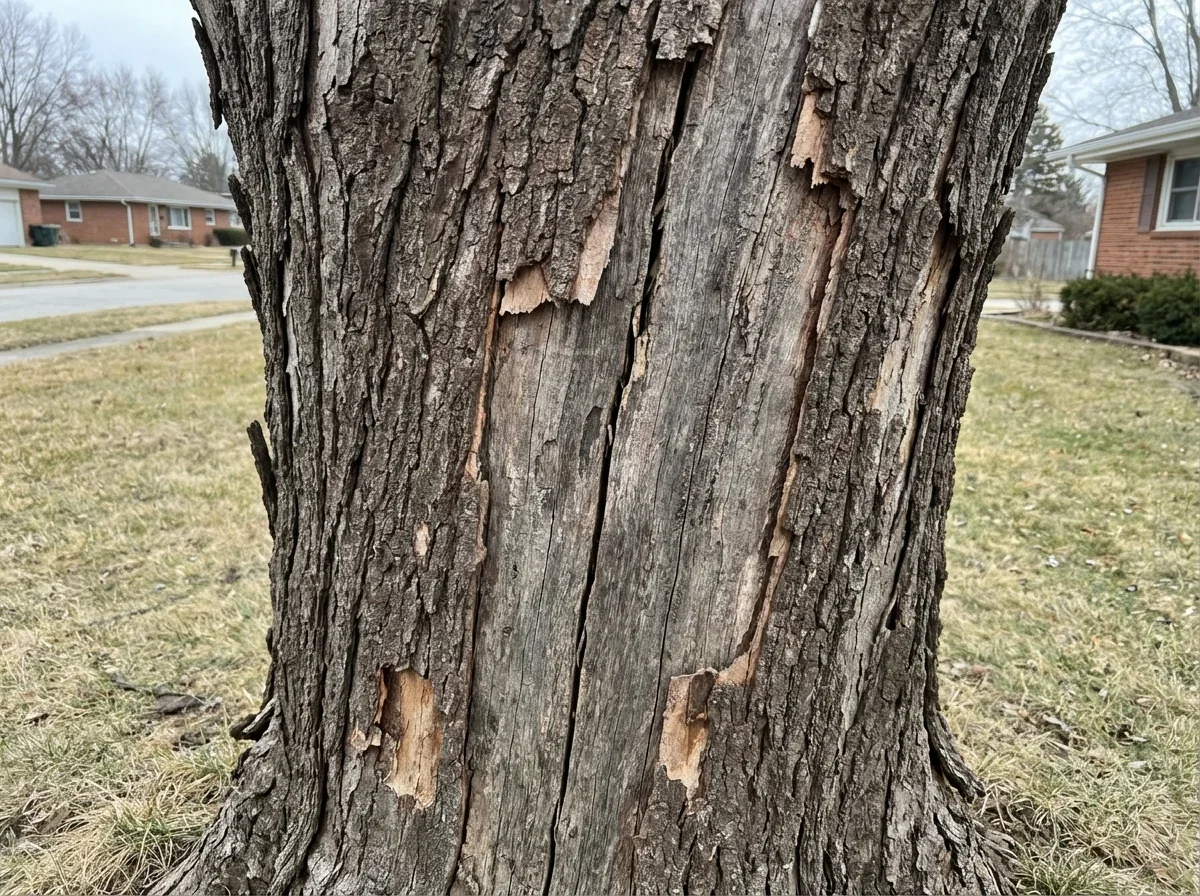
Bark protects the living tissue underneath. When it starts peeling away in large sections or developing deep vertical cracks, the tree's defensive system is breaking down. Healthy bark should be firmly attached and relatively smooth for the species — some trees naturally have textured bark, but it shouldn't be actively separating.
Missing bark patches expose the wood to insects, disease, and weather damage. You might notice these areas first on the trunk's south or west side, where sun exposure is most intense. Sometimes bark damage follows physical injury from lawn equipment or animal activity, but widespread peeling without obvious cause points to internal decline.
Check whether the wood under missing bark is moist and greenish (still alive) or dry and brown (dead). Scrape gently with your fingernail or a knife on a small area. If you see green cambium tissue, that section may still recover with proper care.
Brown, dry wood means that part of the tree is already gone.
Fungus, Mold, or Mushrooms Growing on the Trunk
Mushrooms sprouting from the trunk or major roots aren't just unsightly. They're the visible fruiting bodies of fungi already decomposing the tree from inside. By the time mushrooms appear, significant internal decay has usually been happening for months or years.
Different fungi attack different parts of the tree, but all indicate compromised structural integrity. Bracket fungi (shelf-like growths) often signal heartwood decay, while mushrooms clustered around the base suggest root rot.
The tree may look fine from the outside while being hollow inside, making it a serious safety risk.
Even surface mold or mildew, while less immediately dangerous, suggests the tree is staying too wet or isn't circulating nutrients properly. Persistent moisture problems create ideal conditions for more serious fungal infections to take hold. Professional arborists can assess how much internal decay exists and whether the tree is salvageable.
Quick Assessment Checklist — Signs Your Tree May Be Dying:
- Sparse or discolored leaves during growing season (not fall)
- Multiple dead branches, especially in upper canopy (>25% of major branches)
- Bark peeling away in large sections or deep vertical cracks
- Mushrooms or bracket fungi growing from trunk or base
- Sudden lean or progressive tilting (>15 degrees from vertical)
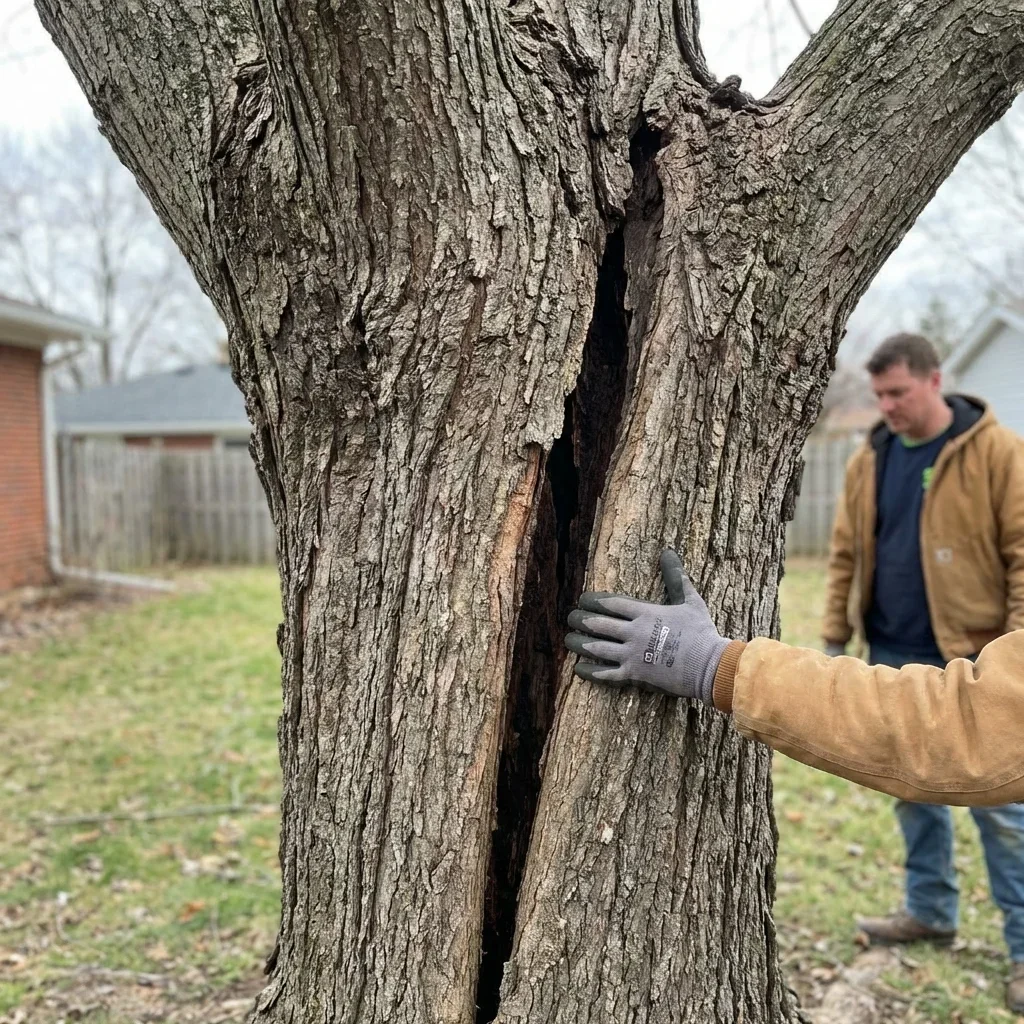
- Deep cracks in trunk or major limbs exposing interior wood
- Exposed roots, root collar decay, or mushy roots when examined
Leaning or Structural Changes
A tree that suddenly develops a lean wasn't just "growing that way." Recent leaning indicates root failure or soil instability. It often happens gradually enough that you might not notice until the angle becomes obvious. Compare your tree's current position to photos from previous years if you have them.
Root damage is the usual culprit behind new leans. Construction, excavation, or even prolonged drought can compromise the root system enough that the tree can't support its own weight anymore. You might see raised soil on one side or exposed roots on the other as the tree begins to tip.
Trees can adapt to gradual leans over many years. But sudden changes, especially after storms, mean the structural support is failing now.
A leaning tree is a falling tree in slow motion. If the lean is progressing or exceeds about 15 degrees from vertical, you need a professional assessment immediately — before it becomes an emergency removal.
Cracks in the Trunk or Major Limbs
Deep cracks or splits in the trunk are like fractures in a bone. They indicate structural failure is already underway. These cracks often start small and widen over time as the tree continues trying to support itself with compromised wood. They're especially dangerous because they can lead to sudden limb or trunk failure without additional warning.
Look for vertical seams that separate the bark, or cracks that reveal interior wood. Some trees naturally develop shallow surface fissures as part of their bark pattern, but concerning cracks will show depth and often run parallel to the wood grain. Cracks that go completely through a branch or form a "V" shape at a branch junction are particularly unstable.
Storm damage, rapid growth, or disease can all cause structural cracks. Once the wood has split, that damage is permanent — the tree can't heal the crack, only try to seal around it. Large cracks compromise the tree's ability to transport water and nutrients, accelerating overall decline.
Root Problems and Exposed Roots
You can't see most of what's happening underground, but surface clues tell the story. Large roots that suddenly become exposed, visible decay at the root collar (where trunk meets soil), or mushrooms near the base all point to root system failure.
The root system needs to be extensive and healthy to support everything above ground.
Roots rotting from disease or sitting in waterlogged soil lose their structural grip. You might notice the tree becoming less stable, soil mounding around the base, or the tree developing a lean. Construction damage is another common killer — severing major roots during excavation or compacting soil over the root zone can doom a tree even if the damage isn't immediately visible.
Healthy roots should be firm and show white or light-colored wood when scratched. Brown, mushy, or foul-smelling roots are rotting.
Since root problems often don't show obvious symptoms in the canopy until significant damage has occurred, by the time you notice leaf thinning or branch dieback, the root system may already be severely compromised.
| Assessment Method | What It Reveals | When to Use It |
|---|---|---|
| Scratch Test | Whether cambium tissue is alive (green) or dead (brown) | First step for any suspected branch or trunk damage |
| Visual Inspection | Surface problems: bark damage, fungal growth, structural cracks | Regular seasonal checks, especially spring and after storms |
| Professional Arborist Assessment | Internal decay, structural integrity, safety risk level | Multiple warning signs present or safety concerns |
What to Do If You Spot These Signs
Start with the scratch test on a few branches: gently scrape away a small bit of bark with your fingernail. Green tissue underneath means that branch is alive. Brown means it's dead. This quick check helps you gauge how widespread the damage is. Do this test in several locations around the tree — upper branches, lower branches, different sides of the trunk.
A certified arborist can perform a detailed risk assessment following standardized protocols that evaluate visible defects, decay, and structural integrity.[3] They'll determine whether the tree poses safety risks and if any treatments might help. Some problems like nutrient deficiencies or pest infestations are treatable if caught early. Advanced decay or root failure usually means removal is the safest option.
Don't wait if multiple warning signs are present or if dead branches are positioned where they could hit structures or people when they fall. Trees can decline slowly over years or fail suddenly during the next storm.
Professional assessment gives you a clear picture of what you're dealing with and what timeline you're working with for decisions.
Frequently Asked Questions
- Mississippi State University Extension. "Tree Health Assessment and Risk Management." https://extension.msstate.edu/publications/tree-health-assessment-and-risk-management. Accessed February 09, 2026.
- USU Extension. "Hazard Tree Assessment Management." https://extension.usu.edu/forestry/files/webinars/hazard-tree-assessment-management.pdf. Accessed February 09, 2026.
- US Forest Service. "Field Guide for Tree Risk Assessments and Hazard Tree Mitigation." https://www.fs.usda.gov/sites/default/files/fs_media/fs_document/hazard-tree-field-guide.pdf. Accessed February 09, 2026.