
How Oak Wilt Kills Trees (and Why Red Oaks Die Fast)
Oak wilt is caused by a fungus (Bretziella fagacearum) that clogs the tree's water-conducting vessels. Once infected, the tree can't move water from roots to leaves.
Red oaks have no defense—they're extremely susceptible and typically die within one to four months after infection, with rapid browning starting at leaf tips and margins.[3]
White oaks resist better. Their vessel structure slows the fungus, so symptoms progress over months or even years instead of weeks. Some white oaks wall off the infection and survive.[1]
But don't mistake slow progression for safety—white oaks still spread the disease through shared roots to neighboring red oaks, which then crash fast.
| Oak Type | Symptom Speed | Survival Rate | Typical Timeline |
|---|---|---|---|
| Red Oaks | Rapid (weeks) | Very low | 1-4 months to death |
| White Oaks | Slow (months to years) | Moderate | Can wall off infection |
The fungus spreads two ways: through root grafts underground and by sap beetles that visit fresh wounds during warm months. Root transmission is silent and fast—trees growing within 50 feet often share roots, so one infection becomes a pocket of dying oaks in a season. Beetles spread it tree to tree when they carry fungal spores from infected wood to open wounds on healthy oaks, especially after storm damage in summer.
Early Oak Wilt Symptoms: What Flagging Looks Like
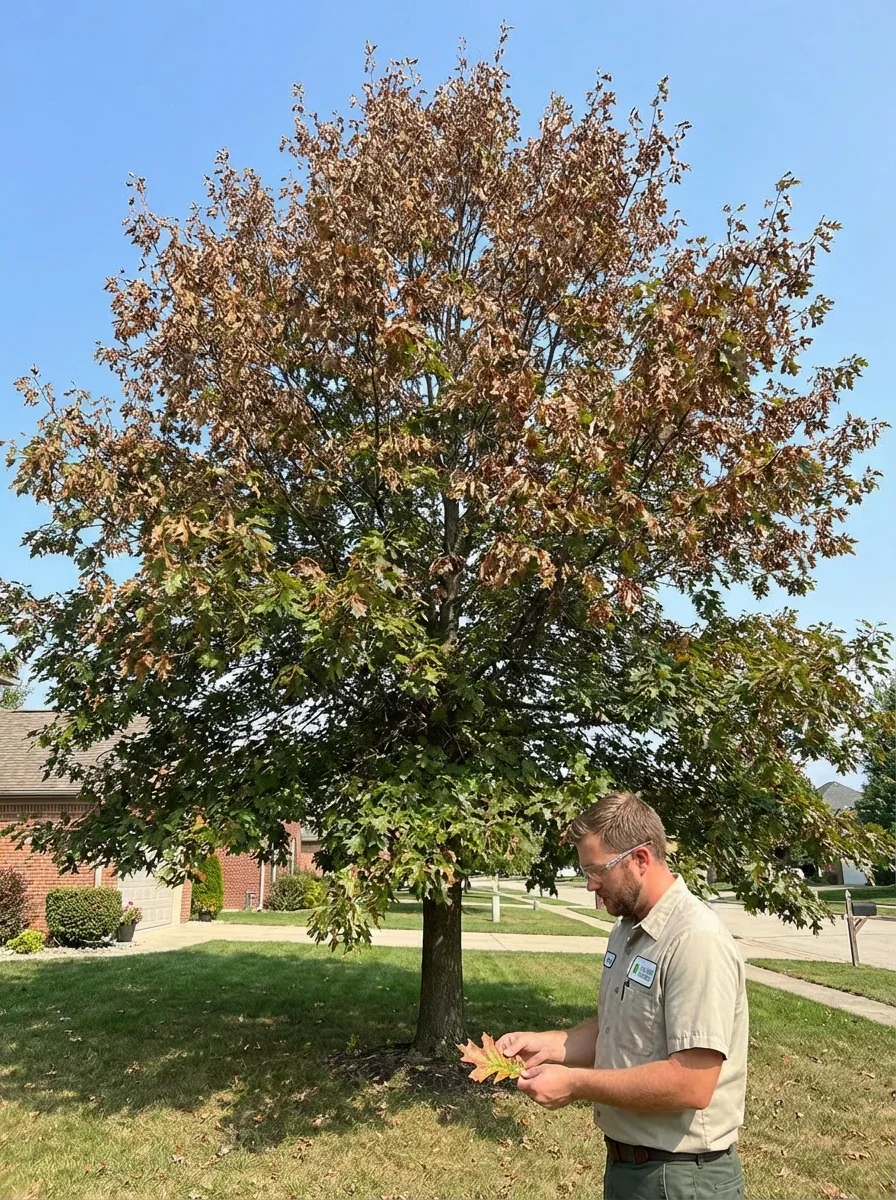
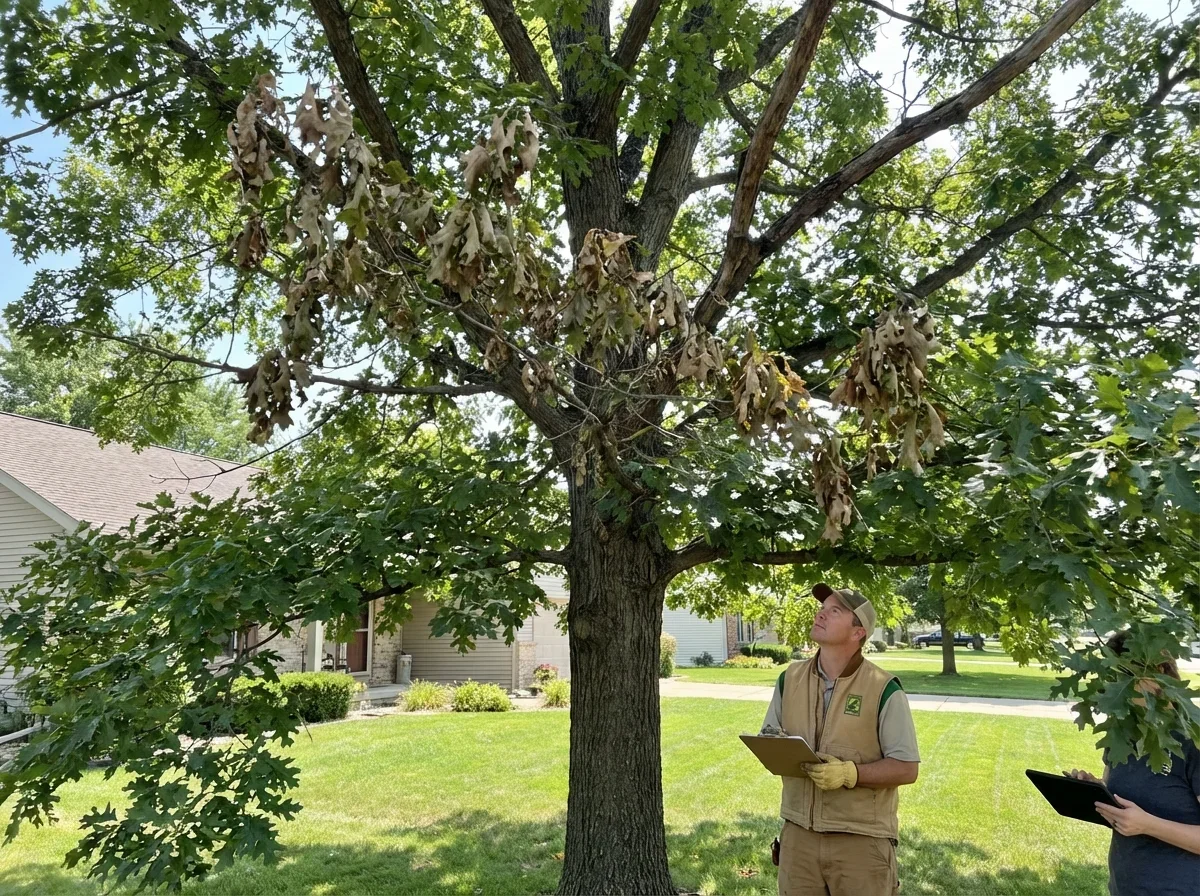
The first sign is subtle. You'll see "flagging"—a few branches in the upper canopy with wilted, discolored leaves while the rest of the tree still looks green.
These flagged branches stand out because the leaves turn dull bronze or tan and stay attached or drop early, breaking the normal summer canopy. Many homeowners miss flagging because it starts high in the crown and looks like minor drought stress or a few dead twigs.
But flagging in June through September—especially on red oaks—is a red flag for oak wilt.[2]
The discoloration spreads fast once it starts, moving from branch tips downward and inward. If you catch flagging early and call an arborist right away, you have a narrow window to confirm the diagnosis and potentially stop the disease from spreading to other trees through the roots.
Wait a month, and you're often looking at a dead tree and infected neighbors.
Red Oak Symptoms: Rapid Browning and Defoliation
Red oaks don't linger. Once symptoms become obvious, the tree is often entirely defoliated within a few weeks.[2]
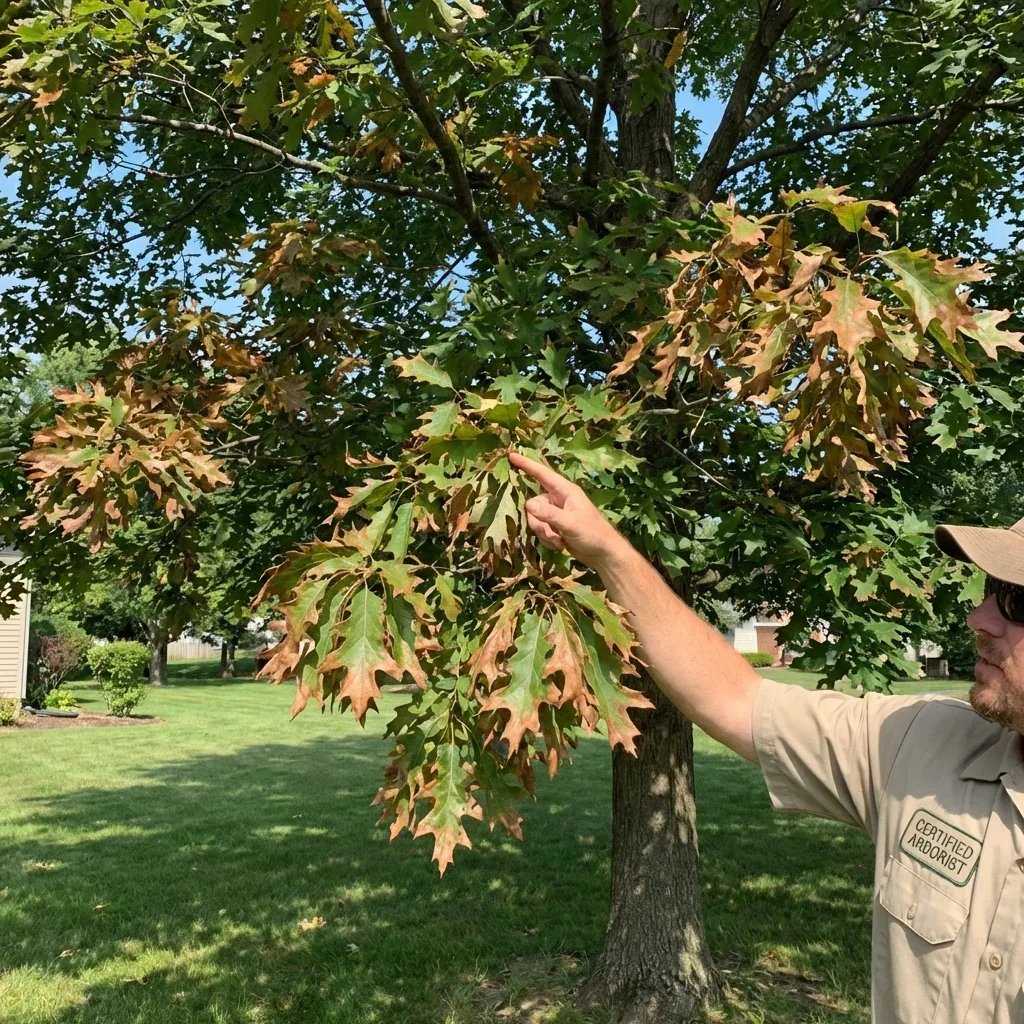
You'll see leaves brown rapidly from the edges inward, starting at the tips and progressing along the margins while the center vein area stays greenish for a short time. The leaves look scorched, not yellowed—more bronze or tan than the bright yellow of nutrient deficiency.
Red oaks lose most of their leaves and die within approximately one month after wilting symptoms appear.[1]
This speed shocks homeowners who expect trees to decline over seasons, not weeks. By the time the whole canopy is brown, the tree is functionally dead, and the fungus is already moving through the roots to adjacent oaks.
Dropping leaves in mid-summer is abnormal. Healthy oaks hold green foliage through August. If your red oak is shedding brown leaves in July, oak wilt is high on the suspect list—especially if neighboring oaks start flagging shortly after.
White Oak Symptoms: Slower Decline, Better Survival
White oaks experience much slower disease progression and may survive infection.[1] Instead of weeks, symptoms unfold over months or years.
You might see a few branches die back one season, then more the next, with the tree holding partial foliage for extended periods. The browning pattern is similar—leaf edges and tips turning bronze—but it doesn't race through the canopy.
Some white oaks wall off the infection and stop the fungus from spreading internally, leading to localized dieback rather than whole-tree collapse. Others slowly succumb over several growing seasons.
Don't let the slow pace fool you into inaction.
White oaks still transmit oak wilt through root grafts to nearby red oaks, which then die rapidly. A lingering white oak infection often seeds a spreading pocket that kills the more vulnerable red oaks around it.
Signs That Oak Wilt Is Spreading Through Root Grafts
If you see multiple oaks declining in a cluster—especially if they're within 50 feet of each other—root graft transmission is likely.
The disease doesn't jump randomly across a yard. It moves systematically through connected root systems, creating expanding pockets of dead and dying trees.
Look for a progression pattern: one tree dies, then its immediate neighbors start flagging the same season or the next. The pocket expands outward in a rough circle as the fungus travels root to root. Trees outside the connected root zone stay healthy until a beetle introduces the disease to a fresh wound elsewhere.
Homeowners often mistake this pattern for drought stress affecting a low-lying area or assume each tree has an individual problem.
But groups of dying oaks indicate root graft spread, not coincidence.
Early recognition of a pocket allows arborists to trench between infected and healthy trees, severing root connections to stop underground transmission.
Key Warning Signs of Root Graft Spread:
- Multiple oaks declining within 50 feet of each other
- Circular or clustered pattern of dying trees
- Symptom progression from one tree to immediate neighbors
- New flagging appearing each season in expanding pattern
- Trees dying in sequence, not simultaneously
Other Clues: Fungal Mats, Bark Cracks, and Beetle Activity
Red oaks killed by oak wilt sometimes develop fungal mats under the bark, typically between fall and the following spring. These mats form in cracks or splits in the bark and smell sweet or fruity, attracting sap beetles.
If you peel back loose bark on a recently dead red oak and find a grayish fungal growth with a yeasty odor, that's a strong confirmation of oak wilt.
You might also notice vertical cracks in the bark where pressure from the fungal mat has pushed outward. Beetles visiting these mats pick up spores, then fly to fresh wounds on healthy oaks—wounds from storm-broken branches, pruning cuts, or construction damage—and deposit the spores as they feed on sap.
Beetle activity peaks from April through July, which is why you should never prune or wound oaks during this window.
A pruning cut made in May becomes an infection site within hours if beetles are active. Many homeowners wish they'd known this restriction before scheduling spring trimming—storm damage in summer exposes trees just as quickly, with beetles arriving in minutes after a branch breaks.
How to Tell Oak Wilt Apart from Drought, Borers, and Other Stresses
Oak wilt gets confused with other problems, delaying diagnosis and letting the disease spread.
Drought stress causes general wilting and leaf browning, but it affects the whole tree more evenly and doesn't kill red oaks in a month. Drought-stressed trees also recover with rain; oak wilt doesn't reverse.
Borer damage shows up as D-shaped exit holes in the bark, sawdust trails, and dieback starting with individual branches over time, not the rapid whole-canopy collapse of oak wilt. Two-lined chestnut borers often attack oaks already weakened by wilt, compounding the confusion.
Defoliators like spongy moth strip leaves but don't cause the bronze, edge-in browning pattern of oak wilt, and trees usually releaf after insect feeding stops. Oak wilt browning starts at leaf margins and tips, progresses inward while the leaf stays partially green, then the leaf drops.
The timing matters too—oak wilt symptoms peak June through September, not spring.
If you're unsure, call an arborist or your state extension office for a diagnosis. In Wisconsin, the DNR can test samples to confirm oak wilt before you commit to expensive removal or treatment.
Misdiagnosis wastes money and lets the real problem spread unchecked.
What *Not* to Do: Pruning and Wounding Restrictions
Do not prune oaks from April through October unless you immediately seal all cuts with latex paint or wound dressing.
This restriction surprises homeowners who schedule routine trimming in spring or summer without realizing they're opening infection pathways during peak beetle season.
Fresh wounds—pruning cuts, broken branches, torn bark from lawn equipment, construction scrapes—release sap that attracts beetles carrying oak wilt spores. A cut made in June can become an infection point within 48 hours if beetles visit before the wound dries.
Painting wounds right away blocks beetle access and reduces risk, but avoiding wounding altogether during warm months is safer.
Storm damage complicates this. You can't control when a branch breaks, but you can paint the wound as soon as possible—within hours if beetles are active. Many arborists keep spray cans of latex paint on hand specifically for emergency storm wounds in summer.
If a major limb snaps in July, don't wait days to address it.
The safe pruning window is November through March, when beetles are inactive and the fungus spreads more slowly. Schedule any elective trimming, cabling, or removal during dormant months to eliminate the beetle transmission risk entirely.
Critical Timing Rule: Never prune oaks April through October. Beetle activity during warm months turns every fresh wound into a potential infection site. One mistimed pruning cut can introduce oak wilt to a healthy tree within 48 hours.
Next Steps If You Suspect Oak Wilt
Call an arborist or extension forester immediately if you see flagging, rapid browning, or multiple oaks declining in a cluster.
Early professional diagnosis gives you options—trenching to sever root grafts, removing infected trees before they spread the disease further, or injecting fungicide into high-value oaks at the edge of an infection pocket.
Don't move firewood from infected trees off your property. The fungus survives in dead wood, and moving logs spreads oak wilt to new areas. Many states restrict oak firewood movement for this reason.
If you need to remove a diseased tree, cut it during dormant months, debark or burn the wood on-site, or chip and bury it to prevent fungal mat formation.
Keep monitoring your oaks every summer, especially if oak wilt is present in your area. Early detection of new flagging—before the whole tree browns—gives arborists time to act.
Once red oaks fully decline, the focus shifts to protecting the remaining healthy trees through trenching and careful wound management, not saving the infected one.
Frequently Asked Questions
- Wisconsin Department of Natural Resources. "Oak Wilt - Wisconsin DNR." https://dnr.wisconsin.gov/topic/foresthealth/oakwilt. Accessed February 09, 2026.
- New York State Department of Environmental Conservation. "How To Identify, Prevent, and Control Oak Wilt." https://extapps.dec.ny.gov/docs/lands_forests_pdf/oakwiltusda.pdf. Accessed February 09, 2026.
- University of Missouri Extension. "Oak Wilt -- Identification and Management." https://extension.missouri.edu/media/wysiwyg/Extensiondata/Pub/docs/v00006/pestalertOakWilt01.pdf. Accessed February 09, 2026.