
What Makes a Tree Hazardous?
A hazardous tree has structural defects or environmental conditions that increase its likelihood of failing and hitting something — or someone — you care about. Not every tree with a defect is dangerous. The key is whether failure is likely and whether a target (your house, driveway, neighbor's property) sits within the striking distance if it falls.[2]
Risk comes down to three factors: the defect itself, how likely the tree is to fail because of it, and what's in range if failure happens.
A leaning tree over an empty field is low risk. The same lean over your garage? That's a different conversation.
| Risk Factor | Low Risk Example | High Risk Example |
|---|---|---|
| Defect Location | Small cavity in outer branch | Large decay at trunk base |
| Target Proximity | Tree leans toward empty field | Tree leans toward house/garage |
| Failure Likelihood | Minor crack, healthy wood | Progressive lean after storm |
| Urgency Level | Annual monitoring | Immediate action required |
Common Warning Signs of a Hazardous Tree
Dead or Hanging Branches
Dead wood is brittle and unpredictable. Large dead branches — sometimes called "widow makers" — can snap without warning, especially during storms or high winds.
If you see multiple dead limbs in the canopy or branches hanging loosely after a storm, the tree is already shedding parts of itself. Removing a dead or damaged tree isn't just about aesthetics; it's about stopping the next failure before it happens.
Visible Decay, Cavities, or Cracks
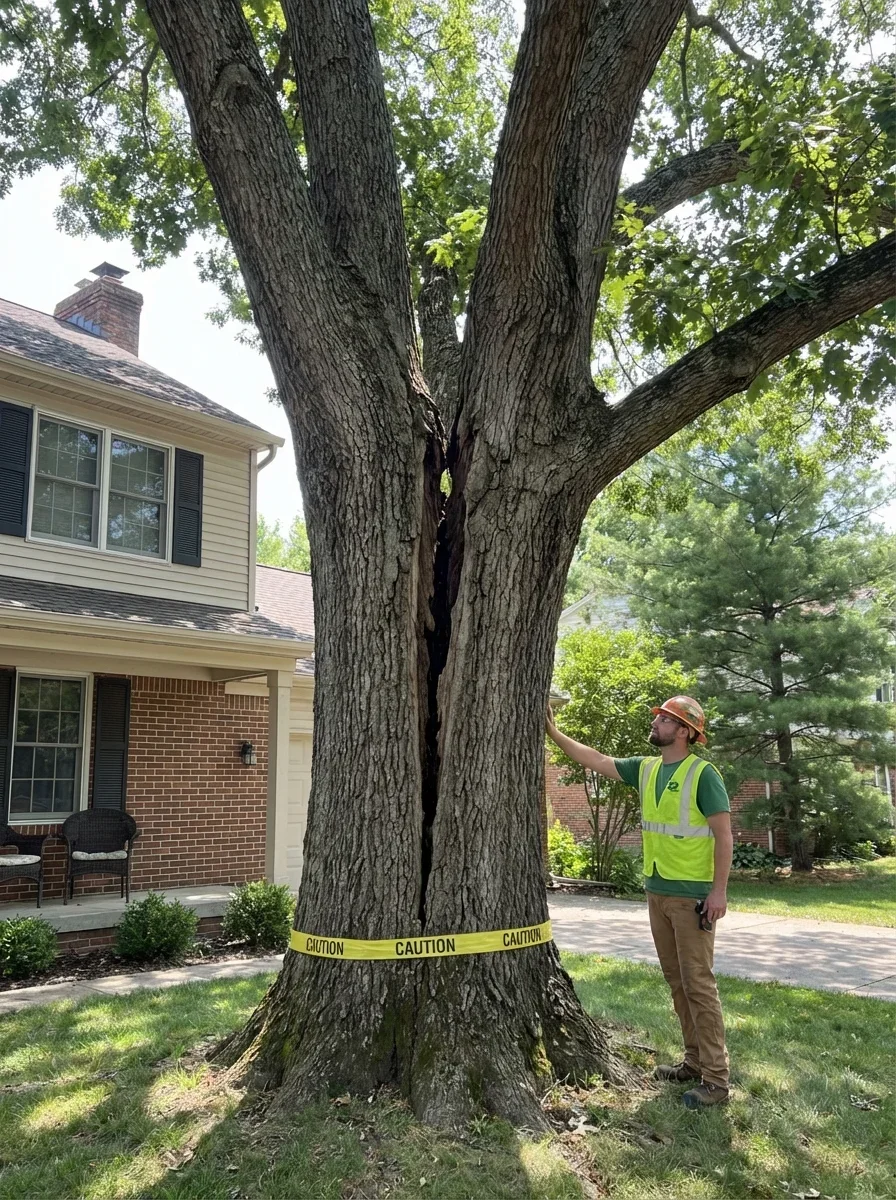
Cavities at the trunk base, fungal growth (mushrooms or conks), or visible cracks along the trunk are signs that decay is eating away the tree's structural integrity from the inside. The ISA Basic Tree Risk Assessment Form specifically flags cavities and cracks as defects that compromise load-bearing capacity.[2]
You might not see the damage until it's advanced, but once fungi appear, the decay has likely been progressing for years.
Root Damage or Soil Issues
Root systems anchor the tree and absorb shock from wind. Construction work, soil compaction, or erosion can sever or weaken roots, leaving the tree unstable.
Soil heaving (where roots lift soil near the trunk base) or a sudden lean after wet weather can indicate that the root plate is failing. The assessment form treats soil weakness and root damage as high-priority defects because they undermine the entire structure.[2]
Unbalanced or Leaning Growth
A tree that's always leaned slightly in one direction may be stable. A new lean — especially after a storm or wet spell — is a red flag.
Leans can result from root failure, unbalanced crown weight, or codominant stems (two trunks of equal size competing for dominance). Codominant stems often develop included bark, where bark grows between the two trunks instead of forming strong connective wood, creating a weak union prone to splitting.[2]
How Tree Risk Assessment Works (TRAQ)
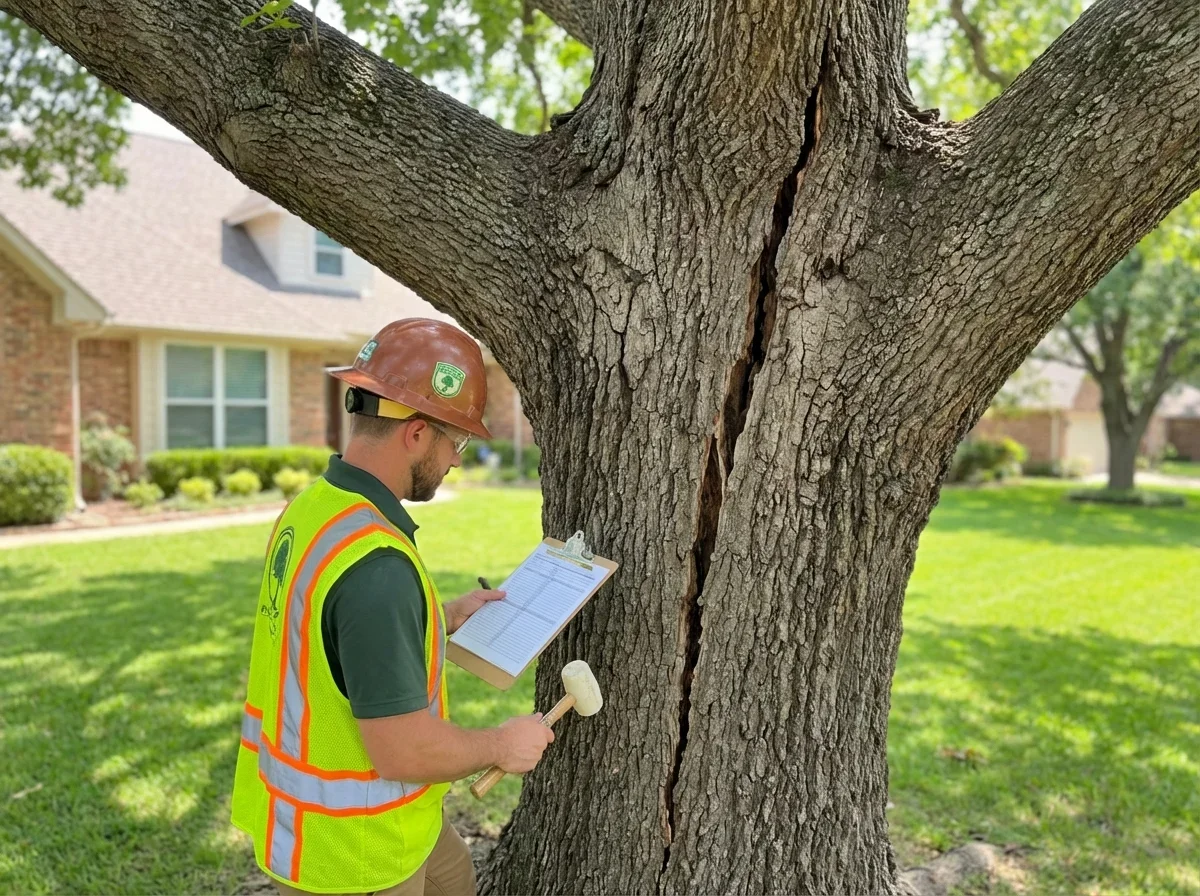
Professional arborists use structured frameworks to evaluate hazard trees, most commonly the ISA Tree Risk Assessment Qualification (TRAQ) process. This is a seven-step evaluation that identifies defects, measures their severity, assesses the size of the part that could fail, and estimates consequences if it does.[1]
The process generates a numeric risk rating — Low, Moderate, High, or Extreme — based on the likelihood of failure and the target within the striking zone. An Extreme-risk tree triggers immediate action: notifying the property owner and restricting access to the danger zone until mitigation happens.[3]
This isn't guesswork. It's a standardized method that accounts for tree-specific and site-specific factors, giving you a clear picture of what you're dealing with.
Homeowners often don't realize the depth of knowledge certified arborists bring to hazard recognition until they see a formal assessment in action. Even emotionally difficult removals — like taking down a decades-old tree — become easier when the evaluation shows you exactly why it's necessary.
What a Professional Tree Risk Assessment Includes:
- Visual inspection of trunk, branches, roots, and surrounding soil
- Measurement of defect size and location relative to load-bearing wood
- Evaluation of nearby targets (structures, vehicles, pedestrian areas)
- Probability rating: Improbable → Possible → Probable → Imminent
- Consequence assessment if failure occurs
- Final risk rating: Low, Moderate, High, or Extreme
- Written documentation with recommended mitigation steps
Likelihood of Failure: How Arborists Assess Probability
Not every defect means imminent collapse. The ISA framework categorizes failure likelihood into four tiers: Improbable, Possible, Probable, and Imminent.[2]
- Improbable: Defect is present but minor; failure unlikely even under stress
- Possible: Defect is noticeable; failure could happen under severe conditions (heavy wind, ice load)
- Probable: Defect is significant; failure expected under normal weather within a predictable timeframe
- Imminent: Failure is likely very soon, regardless of weather
A crack running halfway through the trunk or a heavily decayed base would rate as Probable or Imminent. A small cavity in a healthy tree might be Improbable.
The distinction matters because it determines urgency and whether you need emergency tree service or can schedule removal during the next maintenance cycle.
What Counts as a "Target" in Risk Assessment
A hazardous tree only becomes a true liability if something valuable sits within its fall zone. The target could be your home, a car, a fence, a sidewalk, or even a neighbor's property.
If the tree is in a remote corner of your lot and failure would only drop wood into an empty field, the risk rating stays low even if defects are present.[2]
Arborists measure the striking distance — the radius around the tree equal to its height plus the length of the largest defective part. If your house, driveway, or power lines fall within that zone, the consequences of failure escalate. That's when moderate defects turn into high-priority problems.
Liability and Legal Concerns for Hazardous Trees
If a hazardous tree on your property damages a neighbor's home or injures someone, you could be held liable — especially if you were aware of the risk and did nothing. Documentation from a certified arborist (a written assessment or hazard report) becomes critical if a claim arises. It shows you took reasonable steps to evaluate and address the danger.
In some municipalities, failing to remove a documented hazard tree can result in fines or enforcement action, particularly if the tree threatens public infrastructure like sidewalks or utility lines.
The liability risk isn't theoretical. Once you know a tree is dangerous, inaction carries legal and financial consequences.
Legal Reality: Once you have documented knowledge of a hazardous tree — whether from an arborist report, a neighbor's complaint, or visible warning signs — you assume responsibility for any damage it causes. Ignorance is not a defense if the danger was reasonably observable.
What to Do If You Suspect a Hazardous Tree
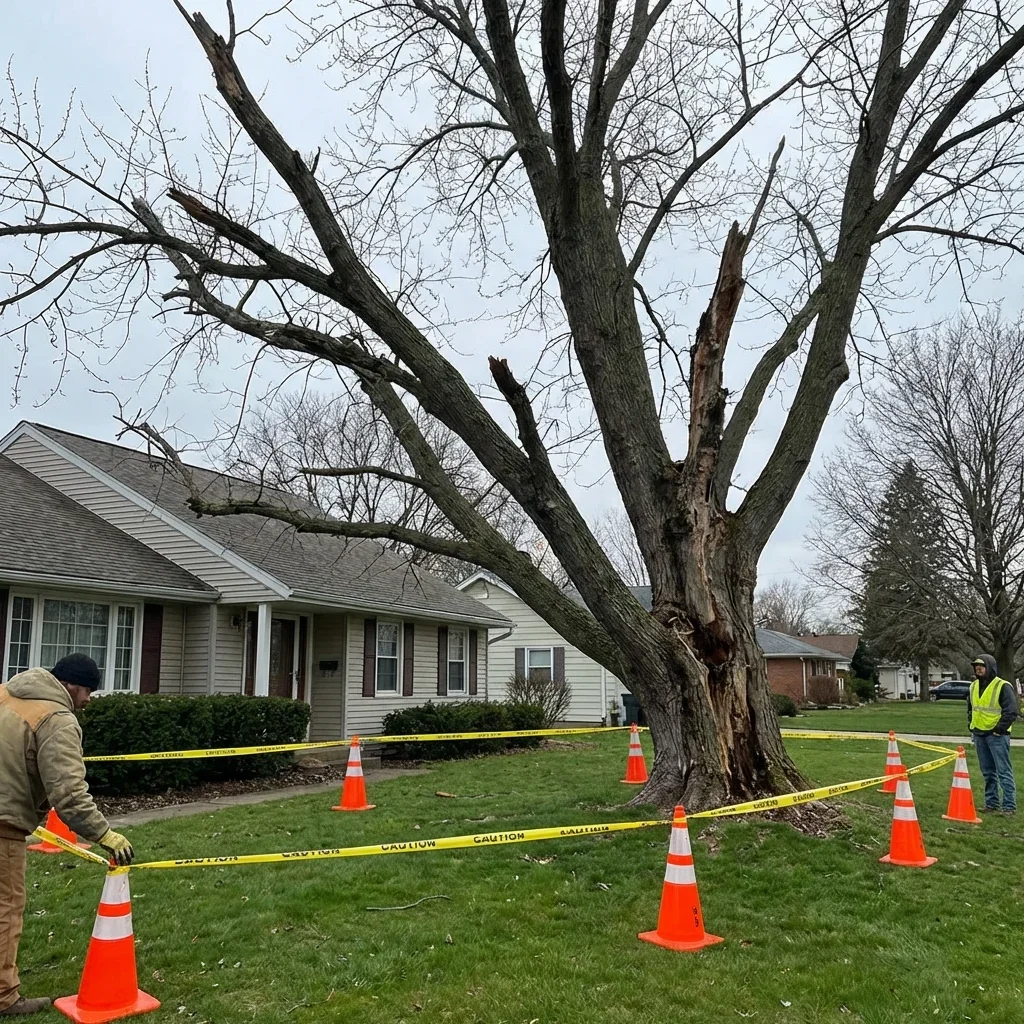
If you've spotted warning signs — dead branches, decay, a new lean, or recent storm damage — start by restricting access to the area beneath the tree. Don't park under it. Keep kids and pets away from the fall zone.
Next, contact a certified arborist for a formal tree risk assessment. Don't rely on a quick visual check from a general tree service. TRAQ-qualified professionals have the training to evaluate defects, measure likelihood of failure, and recommend proportional responses (pruning, cabling, or removal).
Homeowners consistently report that certified experts bring the right equipment and knowledge to handle hazardous situations, even in tight spaces, with thorough cleanup and respect for the emotional weight of losing a longtime tree.
In extreme cases — visible cracks, fresh soil heaving, or a tree leaning toward your house after a storm — you may need emergency tree removal. Don't wait for the next weather event to test the tree's stability.
Can Hazardous Trees Be Saved?
Not every hazard tree needs to come down. Some can be mitigated with structural support (cabling or bracing), targeted pruning to reduce weight and wind resistance, or crown reduction to rebalance the canopy.
If decay is localized and the tree still has significant healthy tissue, an arborist may recommend partial removal of the defective limb rather than felling the entire tree.
The decision depends on the severity and location of the defect, the tree's overall health, and whether mitigation actually reduces risk to an acceptable level. A tree with a failing root plate and a pronounced lean probably can't be saved. A tree with a single codominant stem and minor included bark might respond well to cabling.
The arborist's assessment will tell you which path makes sense.
How Quickly Should You Act?
Timing matters. If the tree is rated Extreme risk — failure is imminent and a target is within striking distance — you need to act immediately. Block off the area and get an arborist out the same day if possible.[3]
For High or Moderate risk ratings, schedule removal or mitigation within weeks, not months. Waiting for a convenient time or hoping the tree stabilizes rarely works. Weather events, seasonal stress, and progressive decay don't operate on your timeline.
Even Low-risk trees with minor defects benefit from monitoring. Ask the arborist to revisit annually or after major storms to check whether conditions have changed.
Proactive scheduling beats emergency calls when a branch finally gives way.
Frequently Asked Questions
- Ohio Department of Natural Resources (Ohio DNR). "Tree Risk Assessment Methods: A Comparison of Three Common Evaluation Forms." https://dam.assets.ohio.gov/image/upload/ohiodnr.gov/documents/forestry/uftoolbox/TreeRiskAssessment-MethodsComparison.pdf. Accessed February 09, 2026.
- International Society of Arboriculture (ISA). "Appendix 1 Using the ISA Basic Tree Risk Assessment Form." https://wwv.isa-arbor.com/education/resources/ISABasicTreeRiskAssessmentForm_Instructions.pdf. Accessed February 09, 2026.
- International Society of Arboriculture (ISA). "Qualitative Tree Risk Assessment." https://wwv.isa-arbor.com/events/conference/proceedings/2013/SMILEY_MATHENY_Tree_Risk_Assessment_Qualitative_AN_Feb_2012.pdf. Accessed February 09, 2026.