
Is Your Tree Actually Dead?
Before you make any decisions, confirm what you're dealing with. Trees can look dormant or stressed without being beyond saving, but a few simple tests will tell you if yours has crossed that line.
The twig test is your fastest answer. Walk up to the tree and snap off a small twig from different branches. If it breaks cleanly with a dry crack and shows no green underneath when you peel the bark, that branch is dead. Do this in several spots around the canopy — if they're all dry and brittle, you're looking at a dead tree.
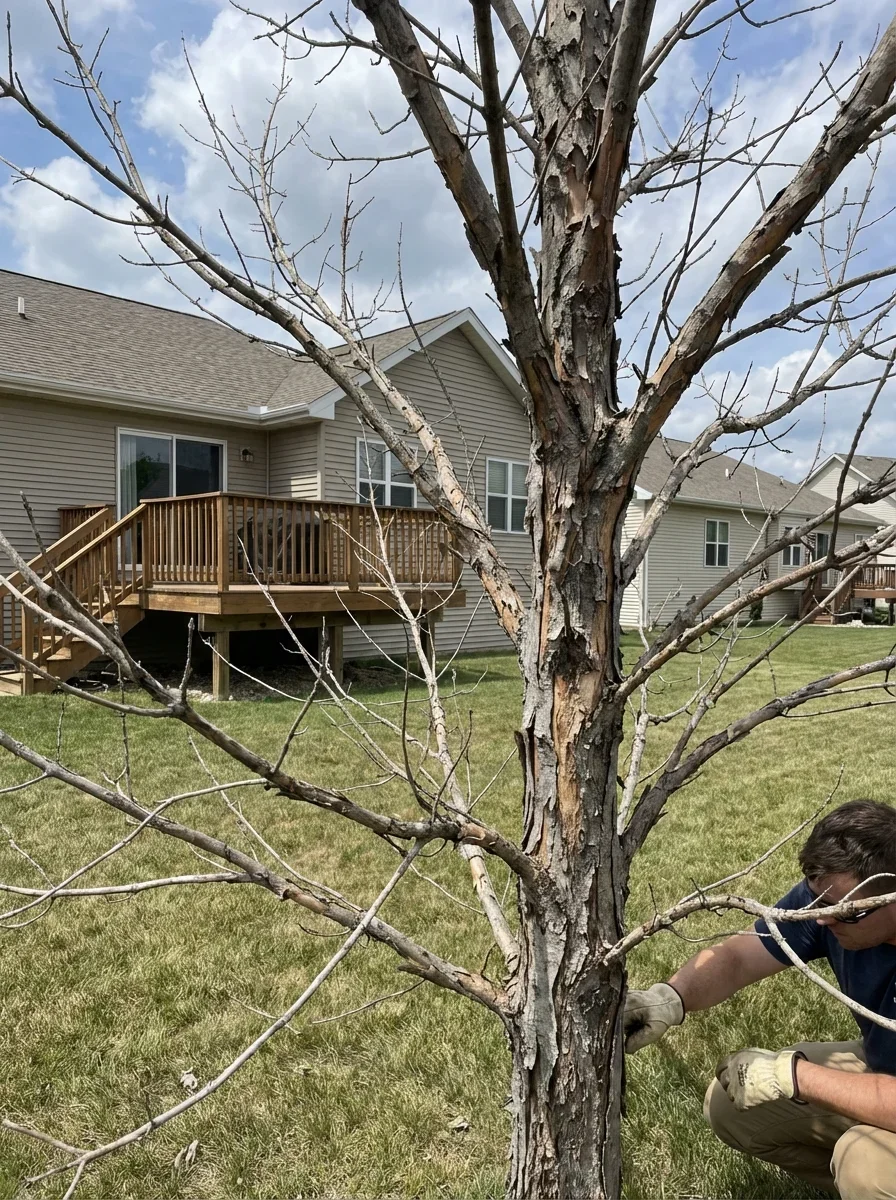
Next, check the bark itself. Healthy trees have a thin green layer called cambium just under the outer bark. Use your thumbnail or a small knife to scratch away a patch of bark on the trunk.
No green layer means no living tissue, and the tree isn't coming back.
You might also notice the bark is loose or falling off in sections — that's decay taking over. Look at the overall structure too. Dead trees often drop smaller branches first, leaving bare spots in the crown or a collection of fallen twigs around the base. If the tree has been leafless through a full growing season while neighboring trees leafed out normally, it's gone.
Quick Signs Your Tree Is Dead:
- Twigs snap cleanly with no green layer underneath the bark
- No cambium (green layer) visible when you scratch the trunk
- Bark is loose, peeling, or falling off in large sections
- Crown has bare spots or significant branch loss
- Tree remained leafless through an entire growing season while others leafed out
Why Dead Trees Are a Safety Problem
A standing dead tree isn't stable. As soon as a tree dies, the wood begins to decay from the inside out, weakening the trunk and major limbs even when everything looks solid from the outside.[1]
This kind of internal rot is difficult to spot until a branch drops or the whole tree starts to lean.
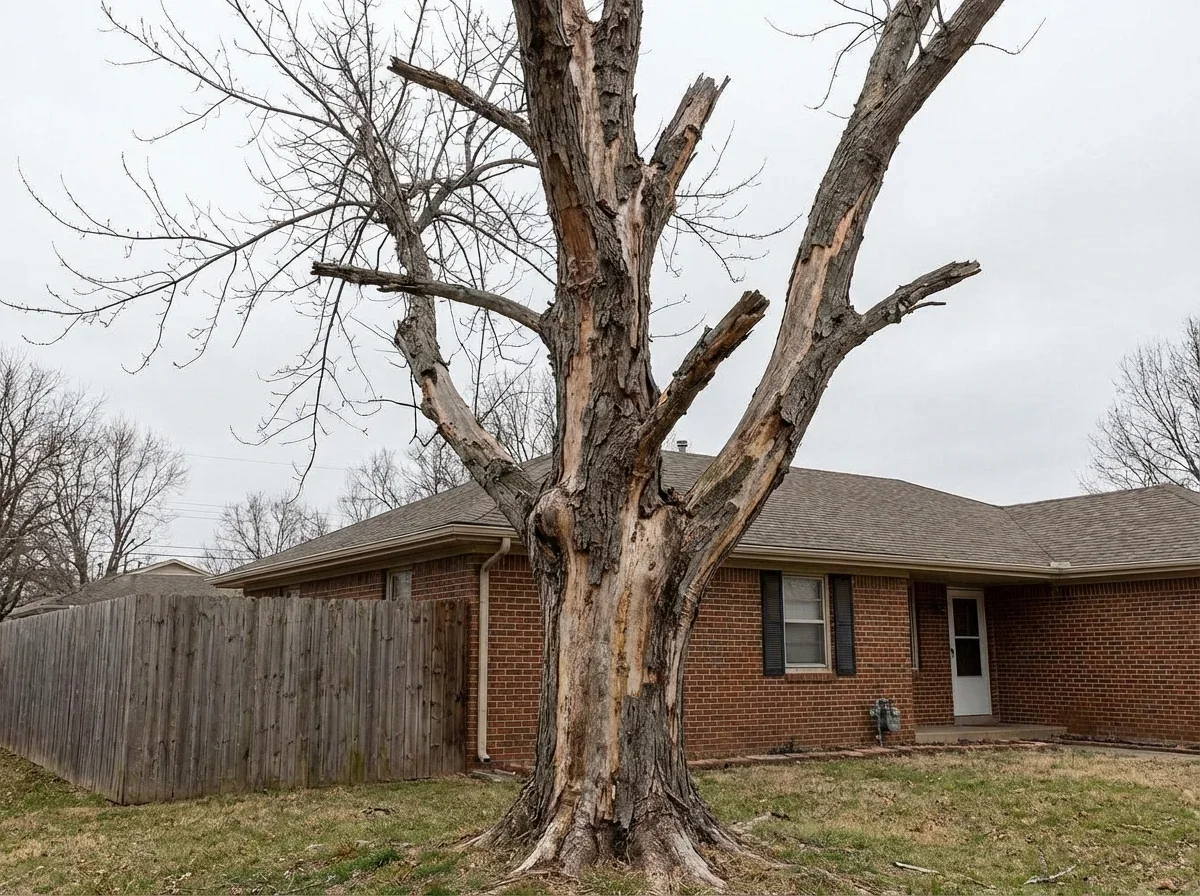
Dead trees are dangerous during storms. Wind that a healthy tree would flex with can snap dead limbs or topple the entire trunk. If your dead tree is anywhere near your house, a shed, your driveway, or a neighbor's property line, it's a liability. One heavy storm is all it takes for a falling branch to punch through a roof or crush a car.
In wildfire-prone areas, dead trees are considered fuel.[2][3] Dry, dead wood ignites quickly and burns hot, turning a controllable situation into something that spreads to structures or adjacent vegetation.
California law requires property owners to remove dead trees and maintain clearance between living trees to reduce fire risk. Regulations vary by state, but the principle holds everywhere: dead trees accelerate danger.
How Long Can a Dead Tree Stand?
There's no universal timeline. A dead tree might stay upright for a year, or it might come down in the next windstorm — it depends on the species, the size, how it died, and what the weather does.
Hardwoods like oak tend to stand longer after death because their dense wood resists decay. Softwoods and trees that died from disease or pest infestation deteriorate faster, sometimes becoming unstable within months. Trees that were damaged or partially uprooted before dying are even less predictable.
You can't bank on a dead tree staying put.
The longer it stands, the weaker it gets, and the less control you have over when and how it falls. Waiting doesn't make removal easier or cheaper — it just increases the chance that the tree makes the decision for you.
| Tree Type | Typical Standing Time | Decay Rate | Stability Risk |
|---|---|---|---|
| Hardwoods (Oak, Maple) | 1-3 years | Slow | Lower initially, increases over time |
| Softwoods (Pine, Fir) | 6 months - 1 year | Fast | Higher, especially after weather events |
| Disease/Pest-Killed Trees | 3-12 months | Very fast | High from the start |
| Storm-Damaged Trees | Days to months | Variable | Extremely high, unpredictable |
What Happens If You Leave It
Some people leave dead trees standing intentionally for wildlife habitat. In remote wooded areas where there's no risk to people or property, that's a reasonable choice. Woodpeckers, cavity-nesting birds, and insects use dead wood as shelter and food sources.
But in a residential yard, leaving a dead tree creates more problems than it solves.
As the tree decays, it drops branches unpredictably. Those branches can damage roofing, fencing, or vehicles, and they're a threat to anyone walking underneath. If the tree is tall enough to reach a power line, a falling limb can cause outages or create a live-wire hazard.
Neighbors notice too. A dead tree leaning toward a shared fence line or within striking distance of someone else's home can become a source of tension or even a legal issue if it causes damage.
Homeowners insurance may not cover damage from a tree you knew was dead and chose not to remove.
Your Removal Options
You have two paths: hire a professional tree service or attempt removal yourself. For most homeowners, calling a certified arborist is the only safe choice.
Dead tree removal isn't the same as cutting down a healthy tree. The wood is unpredictable — it can splinter, collapse unexpectedly, or behave differently than you'd expect when cutting. Professionals use rigging systems, cranes, and bucket trucks to control the process and bring the tree down in sections without letting anything freefall. ISA-certified arborists are trained to assess structural stability and work around hazards like power lines or tight spaces near buildings.
DIY removal is only realistic if the tree is small (under 10-15 feet), far from any structures, and you have experience with chainsaws and felling techniques.
Even then, dead wood is brittle and doesn't always fall in the direction you plan.
If the tree is leaning, hollowed out, or anywhere near something valuable, don't attempt it yourself. Most tree services will provide a free estimate and can often assess the situation within 24 hours. Removal can happen year-round, and many companies handle emergency calls if a storm has left a tree dangling or partially down.
What Removal Costs and What You Get
Pricing depends on the tree's height, diameter, location, and how difficult it is to access. A small dead tree in an open yard might cost a few hundred dollars. A large tree near a house or requiring a crane can run into the thousands, but that cost reflects the equipment, expertise, and liability insurance the crew brings.
Ask if the quote includes stump grinding.
Some services remove the tree and leave a stump flush with the ground. Others will grind it below grade so you can replant or lay sod over the area. Clarify what happens to the wood too — some companies haul everything away, while others will cut logs into rounds and leave them stacked if you want firewood.
A reputable service will carry liability insurance and workers' compensation coverage. If someone is injured on your property or something gets damaged during removal, you want to know their insurance handles it, not yours. Don't hesitate to ask for proof of coverage before work begins.
Pro Tip: Always verify that your tree service carries both liability insurance AND workers' compensation coverage before work begins. If an uninsured worker is injured on your property, you could be held financially responsible. Ask for certificates of insurance and confirm they're current — reputable companies provide this documentation without hesitation.
Acting Before the Tree Does
Once you've confirmed a tree is dead, the clock starts ticking. Removal is easier, safer, and often cheaper when you schedule it on your terms rather than waiting for an emergency.
Get a professional assessment as soon as you suspect a problem.
An arborist can confirm whether the tree is dead, evaluate other trees on your property for signs of disease or instability, and give you a clear picture of what needs to happen. Most offer free inspections and quotes, and the consultation itself can answer questions you didn't know to ask.
If cost is a concern, ask about payment plans or whether the company offers discounts for scheduling during their off-peak season. But don't let budget delays put your property or your family at risk — a dead tree doesn't get safer with time.
Frequently Asked Questions
- UC IPM (University of California Agriculture and Natural Resources). "Recognizing Hazardous Trees." https://ipm.ucanr.edu/PMG/GARDEN/ENVIRON/hazardtrees.html. Accessed February 09, 2026.
- CAL FIRE (California Department of Forestry and Fire Protection). "Defensible Space." https://www.fire.ca.gov/dspace. Accessed February 09, 2026.
- CAL FIRE (via Ready for Wildfire). "Dead Tree Removal." https://readyforwildfire.org/prepare-for-wildfire/dead-tree-removal/. Accessed February 09, 2026.