
D-Shaped Exit Holes in the Bark
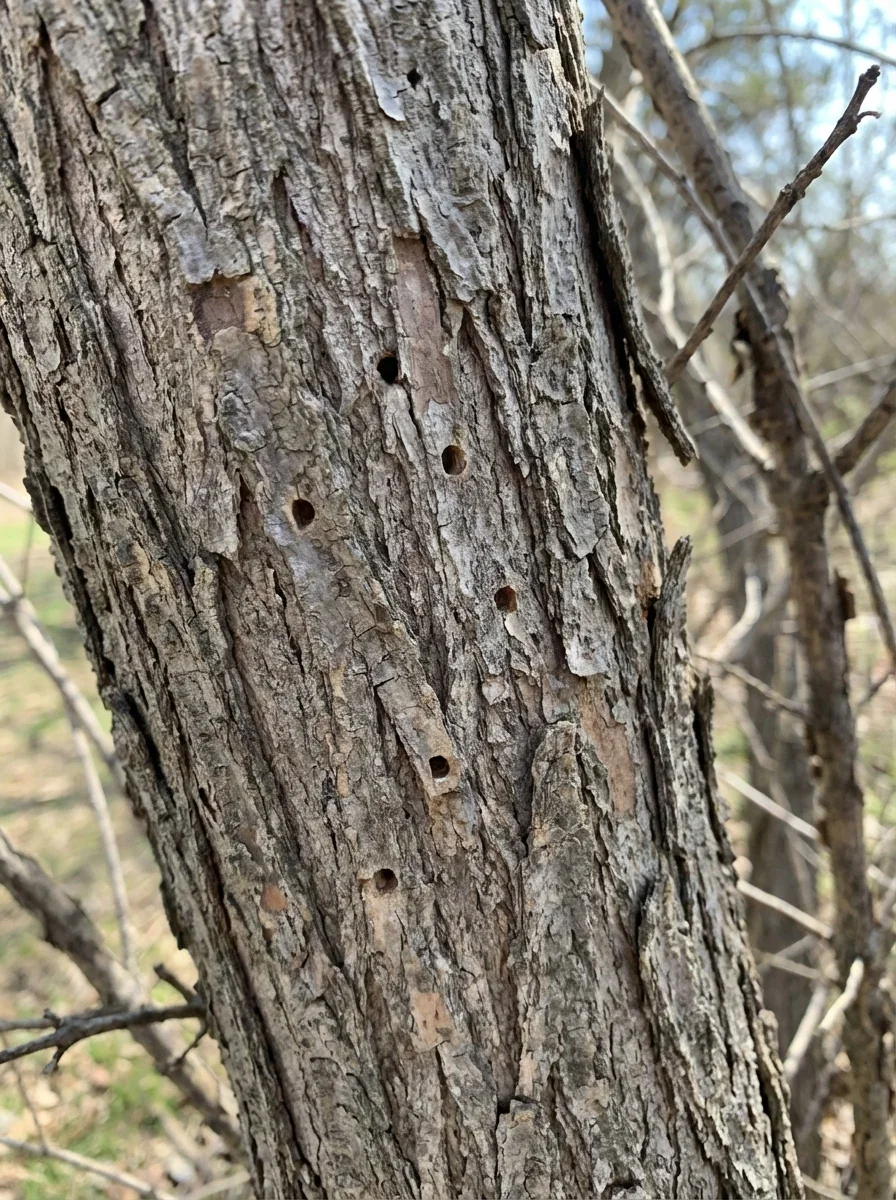
The most distinctive sign of emerald ash borer is the pattern of small exit holes left behind when adult beetles chew their way out of the tree. These holes are roughly 1/8 inch across and distinctly D-shaped, with the flat edge of the "D" running vertically along the trunk or branch.[1]
You'll find these holes scattered across the trunk and main branches, often concentrated where the bark is thinner. They're the clearest proof that beetles have already emerged and are likely laying eggs nearby.
If you see D-shaped holes, your tree has been infested for at least a year — possibly longer.
Canopy Dieback and Thinning
Ash trees under attack lose foliage from the top down. You'll notice the upper third of the canopy thinning out first, with branches dying back and leaves turning yellow or brown earlier than usual.[1] This happens because the larvae feeding under the bark disrupt the flow of water and nutrients to the upper branches.
As the infestation progresses, the entire canopy starts to thin. Trees with more than 50% canopy thinning are poor candidates for treatment and should typically be removed rather than saved.[2]
By the time half the canopy is gone, the tree has sustained so much internal damage that even aggressive insecticide treatments won't bring it back.
If your ash still has a mostly full canopy with just some branch dieback at the top, there's a window to act. Trees with less than 50% canopy loss respond much better to treatment and can recover with proper care.[3]
Critical Treatment Window: The 50% canopy threshold is your decision point. Above it, you're likely wasting money on treatment. Below it, aggressive intervention can still save the tree. Check canopy density every 4-6 weeks during growing season if you suspect EAB.
Vertical Bark Splits and Cracks
Look closely at the trunk and you may notice vertical splits in the bark, sometimes running several feet up the tree. These cracks form directly over the S-shaped galleries that EAB larvae carve as they feed.[1] The tree tries to compartmentalize the damage, but the feeding tunnels weaken the bark structure from the inside out.
Peel back loose bark near these splits and you'll often see the serpentine tracks left by the larvae as they tunneled through the cambium layer.
The wood underneath may look scarred or discolored. These galleries cut off the tree's ability to move water and nutrients between the roots and leaves, which is why infested trees decline so quickly.
Increased Woodpecker Activity
Woodpeckers know a good meal when they see one, and they love feasting on EAB larvae hiding under the bark. If you notice fresh woodpecker damage on your ash — especially large patches of missing bark on the trunk and main branches — it's a strong indicator of an active infestation.[1]
You'll see rectangular or irregular holes where the birds have pecked away bark to get at the larvae underneath.
While woodpeckers do provide some natural control by eating the beetles, their presence is a warning sign that your tree is already compromised. Heavy woodpecker activity often coincides with advanced EAB damage.
Epicormic Shoots (Suckers) on the Trunk
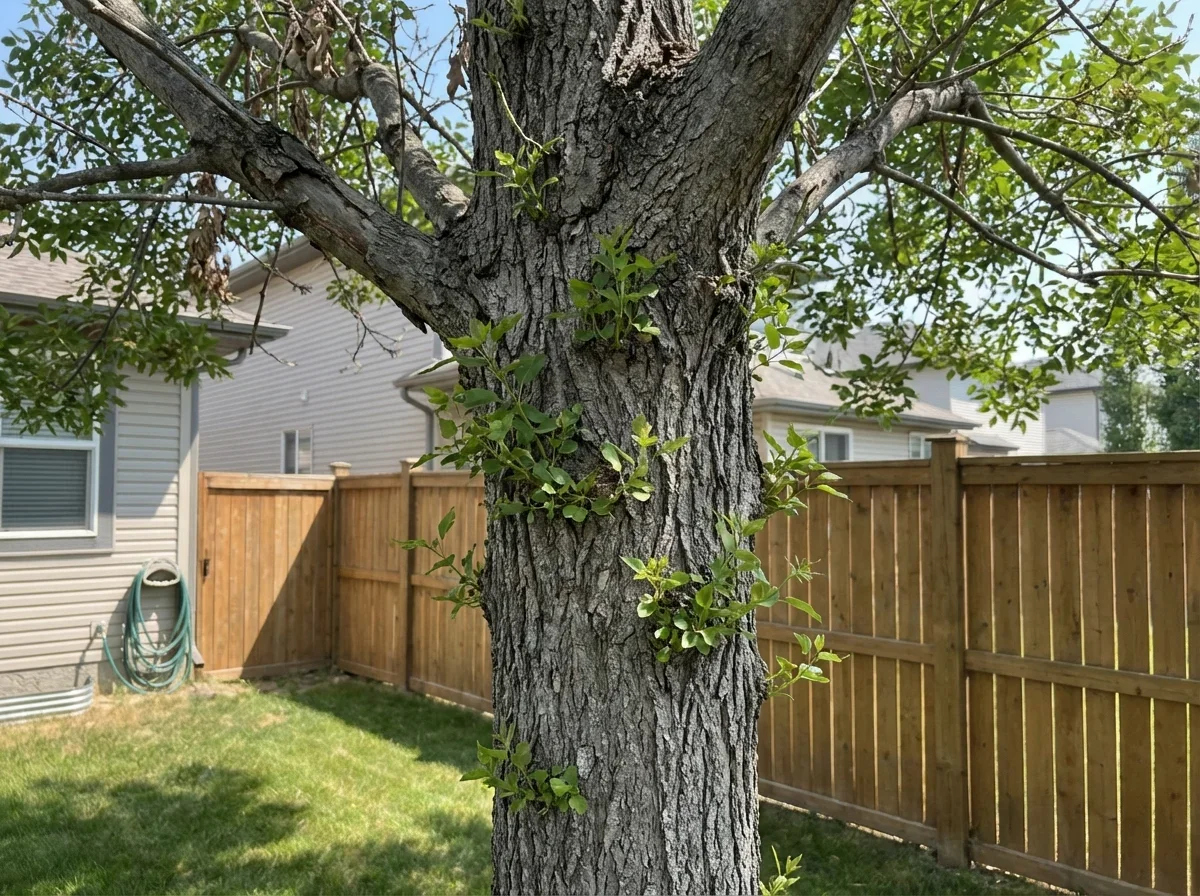
Dying ash trees often respond to stress by producing epicormic shoots — small, leafy branches that sprout directly from the trunk or larger branches below the dying canopy. These shoots are the tree's desperate attempt to generate new foliage after losing its upper branches to beetle damage.
While epicormic growth might seem like a positive sign, it's a red flag that the tree is in serious decline.
These shoots are a last-ditch survival response, and they rarely indicate recovery. A tree covered in trunk sprouts is fighting hard but usually losing the battle.
Key EAB Warning Signs at a Glance:
- D-shaped exit holes (1/8" diameter, flat edge vertical)
- Canopy thinning starting from top down
- Vertical bark splits with S-shaped galleries underneath
- Heavy woodpecker activity on trunk and branches
- Epicormic shoots sprouting from trunk
- Premature leaf drop or yellowing in mid-summer
Premature Leaf Loss and Discoloration
Infested ash trees tend to lose their leaves earlier in the season, and the foliage that remains often looks pale, wilted, or yellowed.[1] This isn't the normal autumn color change — it's a stress response to the disrupted flow of nutrients. You might notice entire branches with leaves that never fully develop or that wilt and drop by mid-summer.
The wilting happens because the larvae feeding under the bark damage the phloem and xylem tissues that transport water and sugars throughout the tree.
Even if the roots are healthy and the soil is moist, the tree can't deliver those resources to the canopy. The result is foliage that looks drought-stressed even in wet conditions.
How Fast Does an Ash Tree Die from EAB?
Once emerald ash borers establish themselves in a tree, the timeline to death is relatively predictable. Most ash trees die within three to four years of heavy infestation.[1]
The larvae spend the winter tucked under the bark, then resume feeding in spring and summer. Each generation compounds the damage, carving more galleries and cutting off more of the tree's vascular system.
Trees in urban or suburban settings sometimes decline faster than those in forests because they're already stressed by compacted soil, limited root space, and heat from pavement. A healthy, vigorous ash in optimal conditions might hold out slightly longer, but the outcome is almost always the same without intervention.
When Treatment Makes Sense (and When It Doesn't)
If your ash tree still has more than half its canopy intact, treatment with systemic insecticides can be highly effective — especially trunk injections, which deliver the chemical directly into the tree's vascular system.[3] Lightly infested trees treated early can fully recover and live for many more years.
But if the canopy is more than 50% gone, removal is the more practical choice.[2]
At that level of decline, the tree has sustained too much internal damage to bounce back, even with chemical intervention. Treating a severely compromised ash is expensive and usually ineffective — the money is better spent on removal and replanting with a non-ash species.
The key is acting fast once you spot the early signs. EAB doesn't slow down, and every season you wait makes recovery less likely.
| Canopy Condition | Treatment Viability | Recommended Action | Typical Cost |
|---|---|---|---|
| <30% loss | Excellent candidate | Trunk injection insecticide | $150-$300/treatment |
| 30-50% loss | Marginal candidate | Aggressive treatment or removal | $150-$300 treatment or $500-$2,000 removal |
| >50% loss | Poor candidate | Remove and replace | $500-$2,000+ depending on size |
| >75% loss | Not viable | Immediate removal (safety risk) | $800-$3,000+ |
What to Do If You Suspect EAB
If you've identified one or more of these symptoms, contact a certified arborist who specializes in emerald ash borer management. They can confirm the diagnosis and assess whether your tree is still treatable. An arborist will evaluate canopy health, look for exit holes and larvae, and recommend either treatment or removal based on the tree's condition.
Don't wait to see if the tree "bounces back" on its own.
Emerald ash borer infestations don't reverse without intervention, and the longer you delay, the fewer options you'll have. Early detection and treatment give you the best chance of saving an ash tree — or at least making an informed decision about what comes next.
Frequently Asked Questions
- Penn State Extension. "Emerald Ash Borer." https://extension.psu.edu/emerald-ash-borer/. Accessed February 09, 2026.
- University of Wisconsin Extension. "Homeowner Guide to Emerald Ash Borer Insecticide Treatments." https://hort.extension.wisc.edu/articles/homeowner-guide-emerald-ash-borer-insecticide-treatments/. Accessed February 09, 2026.
- Minnesota Department of Natural Resources. "Emerald ash borer management." https://www.dnr.state.mn.us/invasives/terrestrialanimals/eab/management.html. Accessed February 09, 2026.